Written by: Moa Aulanko
09.09.26
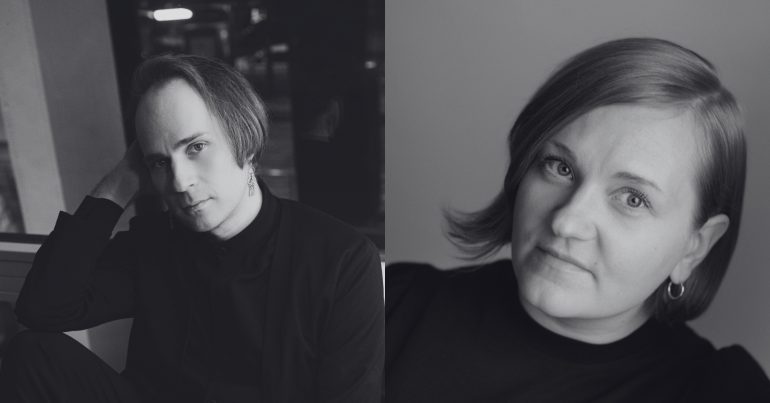
“I hope to say I am a holistic filmmaker, instead of just a micro-managing multi-mediocrity” - director Lauri-Matti Parppei talks about their DIY-attitude, and producer Ilona Tolmunen about making a debut film international from the start.
The Finnish writer-director and musician Lauri Matti Parppei is nominated by the Finnish jury for the Nordic Council Film Prize 2026 for their debut feature film A Light That Never Goes Out (Jossain on valo joka ei sammu). They are nominated together with the film’s producer Ilona Tolmunen.
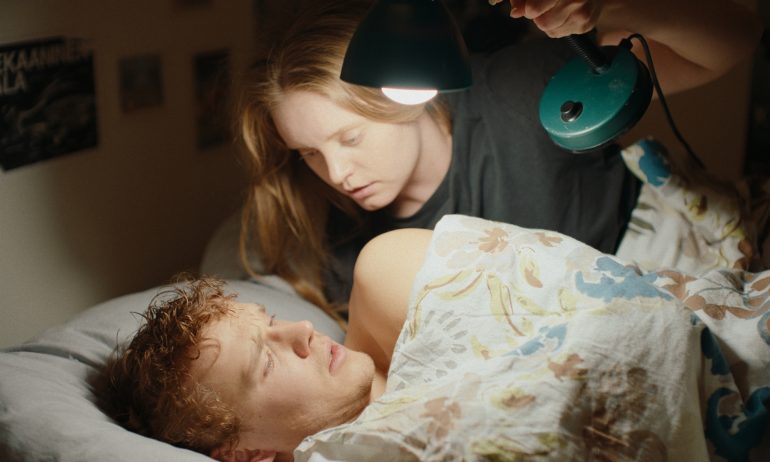
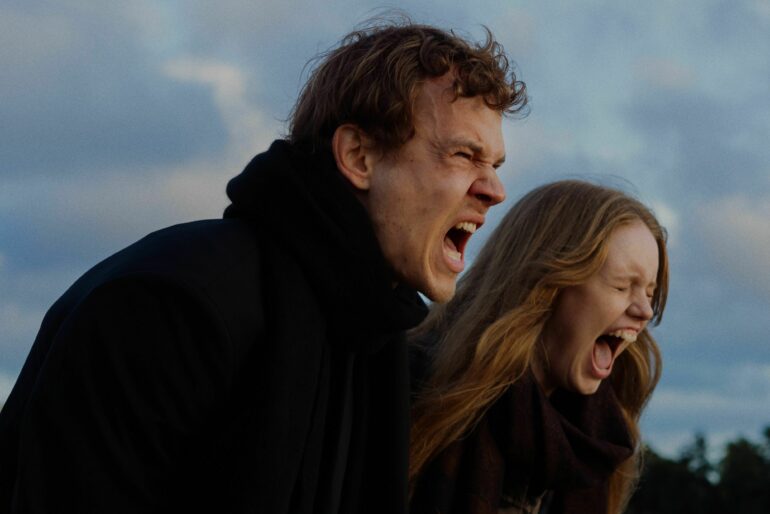
In the film, successful classical flutist Pauli (29) returns to his small hometown after a breakdown. Reconnecting with his old schoolmate Iiris, he is drawn into experimental music. He, who has always sought perfection, is drawn to her chaotic energy and sonic experiments.
Parppei is a filmmaker, musician and visual artist. Their nominated debut feature premiered at Cannes Film Festival in the ACID section in 2025, and won seven Finnish Film Academy Awards (Jussi), including Best Film, Best Directing and Best Screenwriting (CLICK HERE).
Nordisk Film & TV Fond (NFTVF) publishes interviews with all the nominated directors, writers and producers. To all nominees: CLICK HERE.
Writer-director Lauri-Matti Parppei:
What inspired you to make this film?
My background is in the underground music scene. We had very little skills in anything, but we had a burning need to express ourselves and making something that was our own. We ended up starting multiple bands, releasing a lot of albums, which became big hits in nowhere. But none of that mattered, because music gave us a voice and place in the world, and ultimately, we pretty much saved each other.
Making my own first music video for my old band is what originally brought me to filmmaking, as I realised it combined all my interests: music, sound, text and visuals.
I always knew I wanted to depict the feeling of that small musical community in one form or another. I originally tried writing a novel (unsuccessfully), then tried making a short film (unsuccessfully), and over the course of different iterations, the story became this film.
How much of your own experiences found their way into the final film?
While it’s not an autobiographical film, almost everything is somehow lifted from real-life experiences, either from friends’ lives or mine. One of my friends from the underground scene helped us record the music, and after watching us film a scene, he said: “This didn’t happen, but I remember this.”
Both main characters resemble me in different spots of my life. There’s a lot of me in Pauli, after going to the film school, entering the hierarchical film industry, burdened by expectations, and loss of inspiration. Iiris, on the other hand, is like I was back in the day: a scrappy underground musician, who couldn’t care less about hierarchies or the establishment, and way too impatient to make something that matters and makes me heard.
What is your musical background, and how did you use it in the film?
I sang in a choir as a child, I played classical piano for a year or two, and only learned the very basics. I never got into all the rules and theory, but I loved music. I started learning the guitar on my own, and made music by myself in my room. Later, I asked a schoolmate I barely knew to start a band with me, and we’re still on that journey to this day, with other people from the same scene. Everything was highly DIY, and what we didn’t know, we learned, sometimes wrongly.
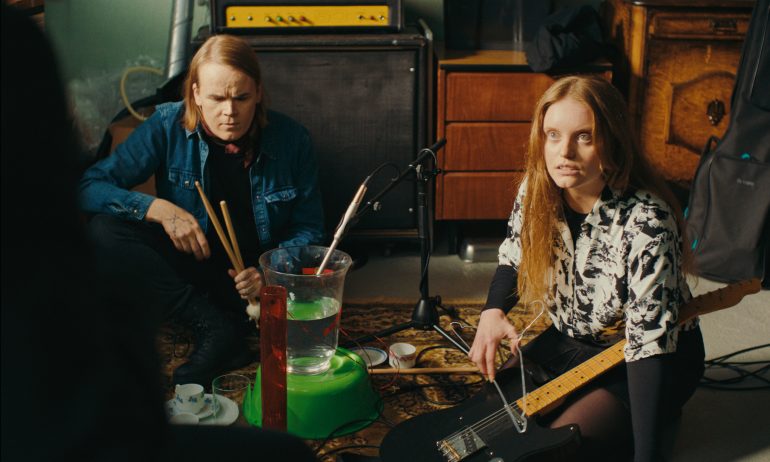
I wrote and produced most of the music in the film, and it was all recorded live, with full takes and no overdubs. It was quite risky, but I am a huge believer in beginner’s luck.
I also made all the contact microphones seen on screen, and had to learn to use soldering iron the night before our first rehearsal. Sometimes the badly made mics broke down while shooting, and I had to fix them myself while trying to direct and handle the musical equipment. It was my idea to take all this responsibility (“how hard can it be?”), so I’m happy my beginner’s luck paid off.
You created the open-source script application Beat while developing the script. How did it help you, and how is Beat doing now?
Back when the film was still in its infancy, I was struggling with a writer’s block due to some unfortunate events, but still wanted to do something around screenwriting. I hated all the existing screenwriting applications, so I learned to program in order to make my own, as a sort of an art project.
True to my DIY background, I immediately released it to the public, and over seven years, the small personal app has become quite a big thing. It has hundreds of thousands of downloads and tens of thousands of active daily users. It’s very special to get e-mails from around the world, be they love letters for Beat – or just bug reports.
Maintaining the app has become a big part of my life, and gives me a nice balance to screenwriting and filmmaking. Making a film can take years, and you never know how it turns out, but with programming, you usually see immediately if something works or not.
This is your feature film debut. What did you learn as a writer-director when moving from the short format to a full-length film?
Me and cinematographer Mikko Parttimaa have been working together for over 15 years, often making zero-budget shorts, and we also made a short-form TV series in 2021. While it all gave me some self-confidence to approach a feature, the shorts were never big festival hits, and I somehow felt I never really grew as a filmmaker.
When we began our work on the feature, we planned it extensively, talking through the style, goals and just plain shots. Part of it was just to prepare for the tight shooting schedule and budget, but also to learn how to make a successful feature. We drew more inspiration from our own previous work than from outside sources, as we knew that there were some strong things, and wanted to refine our approach to filmmaking. I personally became a much better filmmaker during those months of preparation and planning, as I had to be quite honest about my own previous shortcomings. And of course, after seeing the final film, I’ve realised there’s still so much to learn about crystallisation of ideas, and pure technical stuff.
You are not only credited as the film’s writer and director, but also for its music, graphics and foley. Can you describe how you worked in all these roles simultaneously?
I hope to say I am a holistic filmmaker, instead of just a micro-managing multi-mediocrity. However, most of these roles came naturally.
In my youth, I worked as a graphic designer in my small home town, making everything from classical music festival posters to drive-in grill coupons. I was fully responsible for the graphical style of the musical scene we depict. We used actual-real life posters from that era in set design, and those were made by me, and because I still know how to do graphic design, I created other novel set graphics too.
Music was played by the actors, and we arranged the songs together, but I had a very specific vision for the tonal quality and atmosphere, already present in the screenplay, so it was generally easy to take the helm to produce the pieces.
The screenplay describes a lot of sounds, and I was very specific with some of them. Because the film takes place in my home town Rauma, Finland, I very thoroughly knew how it sounds, and as I am pretty experienced with sound myself, it was easy to work on some effects and foley sounds, especially those that needed some local knowledge.
Producer Ilona Tolmunen:
The nominated producer Ilona Tolmunen is the CEO of the Finnish production company Made since 2019. Her credits include the Danish–Swedish–Norwegian–Greenlandic–Finnish–Dutch co-production Kalak (2023), that won two awards at the San Sebastian Film Festival. The Finnish-French-German co-production Heartbeast (Sydänpeto) won two Finnish Film Academy Awards (Jussi). Tolmunen also produced Parppei’s series A Strange Summer (Outo kesä), which was selected for the Short Format Competition in Series Mania in 2022.
The film takes place in the director’s small home town Rauma, known for its wooden centre, its dialect and special humour. As a producer, what was your role in making this local story matter to so many?
Filmmaking is of course a collaborative effort, and everyone brings something valuable to the process. Having grown up in a small village in central Finland, I connected with the story immediately and found it easy to convey its importance to the others. My key role was of course to find the money and the right people to make this film. It was a pleasure that City of Rauma, where the story takes place, gave us a bit of funding and warmly welcomed us to shoot the film there.
Even though the story is very local, it’s also very universal. In many places around the world, you can find similar kinds of stories – “should I stay or leave?”, and “where do I belong?” “Who are the people with whom I can truly be myself?” An essential part of the journey was to be as international as possible during the process: creating the co-production with Norway, pitching the project in Göteborg and Les Arcs, and finding the perfect international sales agent from Germany. She has done an amazing job to sell the film worldwide.
Before this film, you have worked on short films and mini-series with Lauri-Matti Parppei: What were the biggest challenges and moments of joy when producing this film?
The biggest challenge was to get this film funded. It took us over seven years, from the first draft to the premiere. But we never gave up, because we were sure that this film needs to be made. While we were developing A Light That Never Goes Out, we made a short film and a mini-series together. It helped us build mutual trust and confidence in each other’s talent. An important piece of the puzzle is our cinematographer, Mikko Parttimaa.
Finally, we managed to build a co-production with Norway, and we were able to make this film. During the pre-production, shootings and post-production, we had such a lovely and trustful atmosphere. All the crew and cast gave their best, and you can see and feel that from the final film. Having the premiere in the Cannes Acid section 2025 was a dream come true. Following up with a wide festival round and cinema release in many countries was the cherry on top. Receiving seven Jussi Awards, out of ten nominations, and now being the Nordic Council Film Prize nominee, was something we hadn't even dared to dream of!
How would you describe the current state of the film industry in Finland?
The Finnish Film Foundation's funding is significantly lower than in the other Nordics, and this must change. I hope the next government will recognise that the support is not an expense, but an investment that generates economic, cultural, and societal returns, while ensuring that Finnish stories stay alive. A strong public funding ensures that our stories continue to be told and shared, both in Finland and around the world. Even so, every producer and filmmaker has a responsibility to ask themselves whether a story truly deserves to be told, and is it worth making into a film? We have a strong sense of fellowship, and we’re always happy to see our colleagues succeed. The international success of Finnish films has raised the profile of our cinema and set a higher standard for all of us to strive for.
Official trailer:
RELATED POST TO :
AWARDS
/
NORDIC INDUSTRY NEWS
/
FINLAND