Subscribe to newsletter

Get the latest film & TV news from the Nordics, interviews and industry reports. You will also receive information about our events, funded projects and new initiatives.

Navigating between art and attention: Where Is the Nordic documentary market heading?

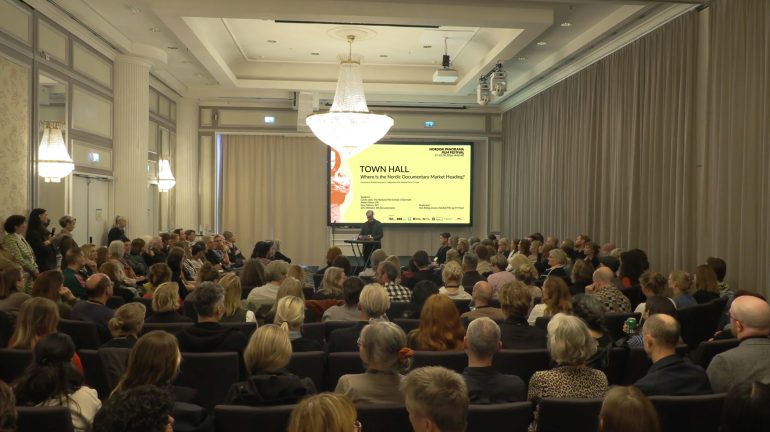
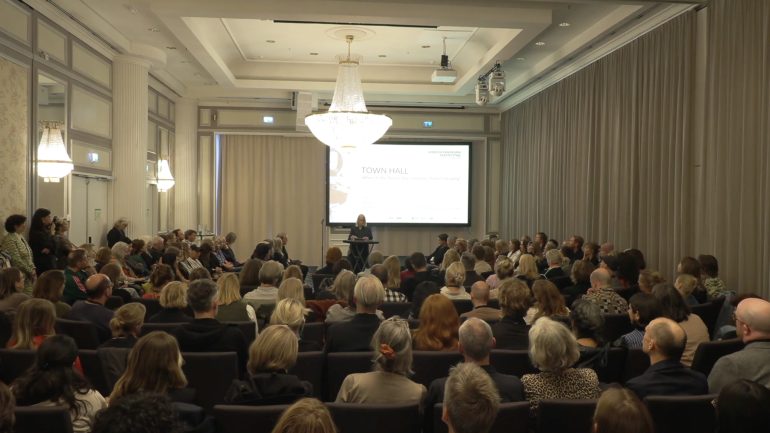
Town Hall at Nordisk Panorama 2026 / Photo: Nordisk Panorama
×
NEWS

Navigating between art and attention: Where Is the Nordic documentary market heading?

Town Hall at Nordisk Panorama 2026 / Photo: Nordisk Panorama

Nordic documentary leaders debate a defining question: How do you preserve artistic ambition while winning the audience public service depends on?

In the summer blockbuster adventure The Odyssey, a memorable episode involves two sea monsters, seated at opposite sides of a narrow strait. The first, Scylla, devours sailors, usually six per gulp. The other, Charybdis, spews out whirlpools, crushing whole ships with cyclonic force. Our hero Odysseus can avoid one, but not both, and will have to make a decision in order to move forward.

The names Scylla and Charybdis live on to this day, typifying the dilemma of having to choose between two “evils”, preferably ending up with the “lesser” one. On rare occasions both can be avoided. In Odysseus' case, that option didn't work out. His choice resulted in half a dozen sacrificed crew mates.

Even the seascape of the contemporary Nordic documentary – in all its internationally celebrated (and at times internationally envied) cross-border cooperation – suffers the occasional Scylla and Charybdis situation. In his opinion piece for Nordisk Film & TV Fond (NFTVF) “Is it suddenly either or for Nordic documentaries?”, seasoned producer Ove Rishøj Jensen, Documentary Advisor at NFTVF, spots a strait of increasing divide, namely the very classic “Nordic model” of such global prominence; a balanced equilibrium where public film institutes safeguard artistic autonomy and creative risk-taking, while national broadcasters provide essential equity pre-sales and linear broadcast windows.

Recently, however, the rapid collapse of passive linear television consumption increasingly forces high-minded documentaries to compete directly against commercial entertainment, social media, and global streaming algorithms where active viewer selection is paramount – also strongly felt in the Nordic region as well as the Nordic cooperation model.

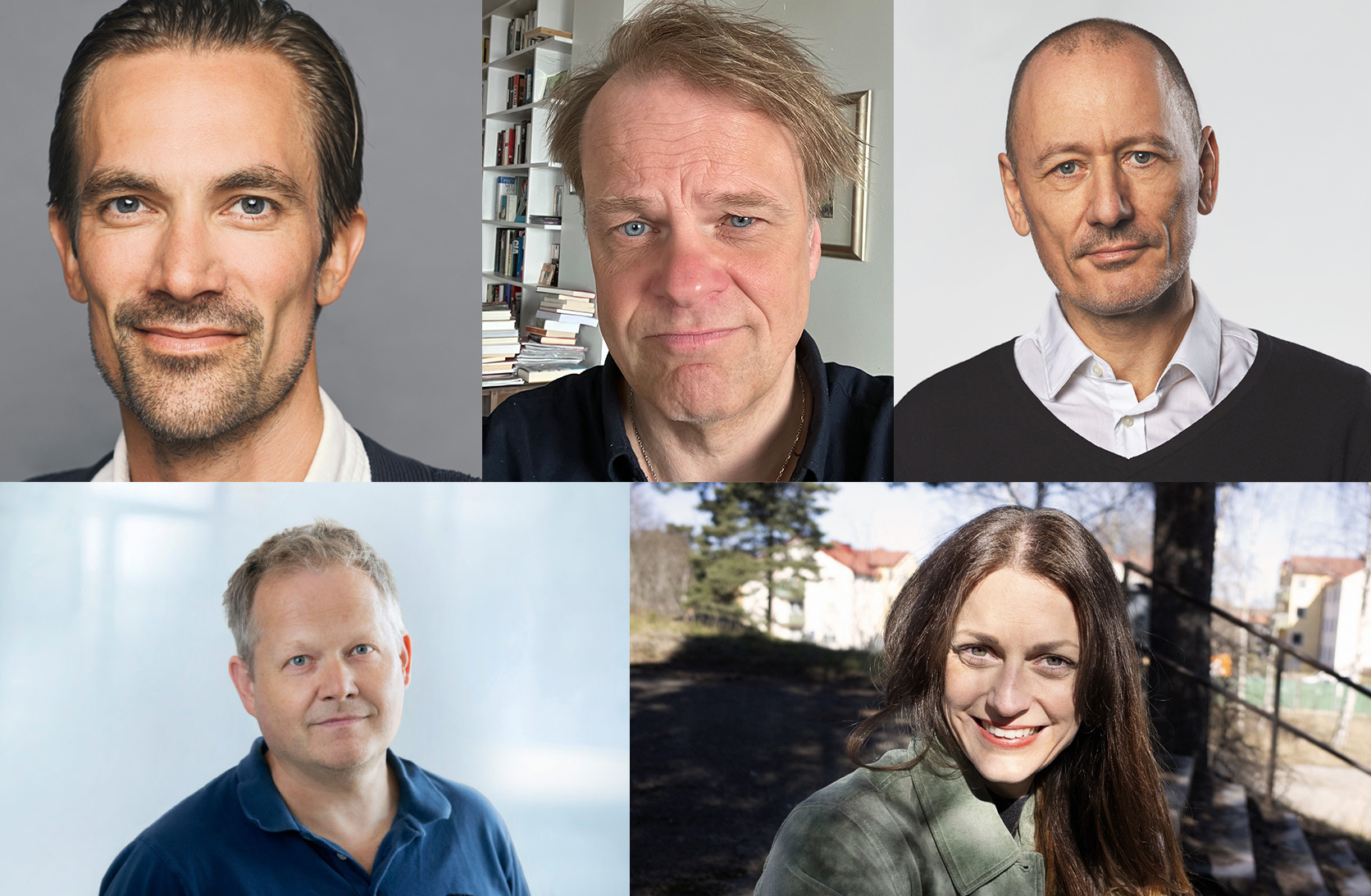
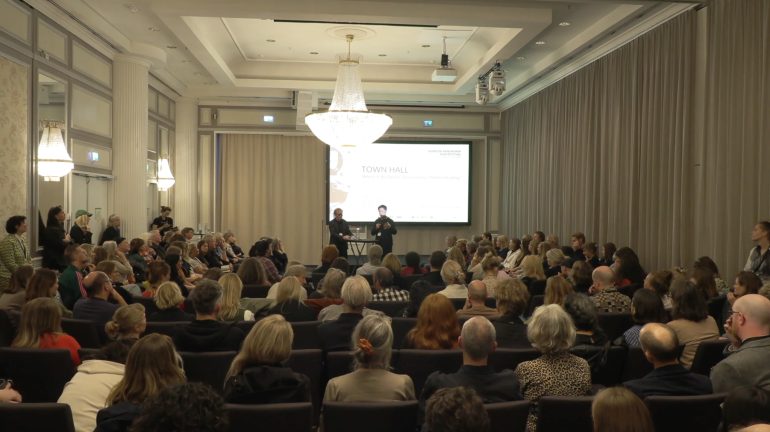
At the 2026 Town Hall session, held during Nordisk Panorama in Malmö, where Rishøj Jensen served as moderator, he brought the dilemma to a table labelled “Where Is the Nordic Documentary Market Heading?”. Four invited speakers shared positions, predictions and possible solutions, all of them well-travelled, well-grounded and well-skilled navigators, willing and able to face the eye of the hurricane.

First out was Cecilia Lidin, currently at the Danish Film School, with a history as documentary consultant at both the Swedish Film Institute (2011-15) and the Danish Film Institute (2015-20). By her own admission – both “over the hill” and “no longer in the eye of the hurricane”, she provided a solid voice of experience, “slightly from the outside”.

“I'm hard-pressed to remember a time it was not a challenge to find common ground for the projects initially funded by the film institutes, institutions whose reason to be is to support art, and on the other side the broadcasters that worried about their audiences and always seem to have the final say with their access to said audience as a trump card that beats all.”

Lidin attempted to find new ways to support and finance documentary films in the Nordic region – “if that means blowing up a well-established business model, so be it” – but ended up delivering a staunch defense of the classic Nordic co-production model, warning that falling broadcaster investments threaten the regional ecosystem, while cautioning against replacing proven structures with redundant institutional grant layers.

×
NEWS

Navigating between art and attention: Where Is the Nordic documentary market heading?

Town Hall at Nordisk Panorama: Cecilia Ledin / Photo: Nordisk Panorama

She critiqued the newly announced joint initiative between the Nordic film institutes and public broadcasters for imposing redundant application layers and additional pitching sessions on filmmakers without expanding the underlying funding pool.

"The truth is that the professional industry that has been built over the last 20-plus years with established and competent producers...is about to implode. I've heard well-established producers say that they are standing on a burning platform. Instead of my initial thought to throw the baby out with the bathwater and find new ways to support and finance documentary films in our region, let us not give up on this structure that has given us the position we have today."

From the two public broadcasters DR and SVT came some pragmatic and reasonably reassuring reality checks. Anders Bruus is the Commissioning Editor & Executive Producer, Documentary Films and Series at DR, Denmark, where he has worked with international documentary films and series since 2008.

“I think we still have the best conditions in the world for making documentaries,” Bruus started out, and added his confidence in the still-prevailing audience trust enjoyed by the public Nordic broadcasters. “SVT, NRK, DR, Yle and so on, we are bigger than the streamers, the big tech – and that’s not the way we want to go.” At the same time, he readily concurred with Lidin’s deduction regarding the ever-looming challenge of artistic quality vs. audience numbers. “We used to have a “built-in” audience – who watched what we showed, like 2-300,000 as a minimum and going up from there. That's not the case anymore. Watching today, via streaming, is an active choice. The gap is getting bigger and bigger between the broad and the really niche. We’re competing with everything, with sleep, with reading a book, with sports. We need attention, otherwise we'll have sometimes 1,000 sometimes zero people watching our film.”

×
NEWS

Navigating between art and attention: Where Is the Nordic documentary market heading?

Town Hall at Nordisk Panorama: Anders Bruus / Photo: Nordisk Panorama

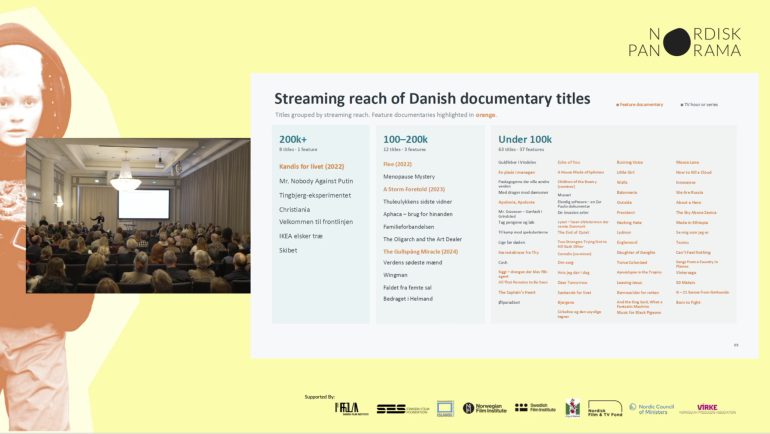
To combat viewer drop-off, Bruus detailed DR’s strategy of reformatting feature documentaries into multi-part digital series, splitting a 90-minute feature into two 45-minute episodes. “We even did it with Mr. Nobody Against Putin. We put it out like 2 x 45 minutes. It went really well, 7-800,000 or so.”

Bruus proceeded with presenting some recent numbers, where several titles, among them A New Kind of Wilderness (Ukjent landskap, 2024), The Gullspång Miracle (Miraklet i Gullspång, 2025) and Mr Nobody Against Putin (2025), showed at least over 200,000 streams, while others, including some highly acclaimed festival titles, resided in the below 10,000 brackets, “up against Married at First Sight (Gift ved første blik), sports, and what have you”.

“We still think they're great films. We will still keep doing them. But I hate seeing really good films watched by almost no one. Because then, who is it for?”

From Sweden’s SVT, Asta Dalman is Commissioning Editor, current affairs and feature documentaries at SVT, Sweden, since 2020, and specialises in Nordic co-productions and pre-buys.

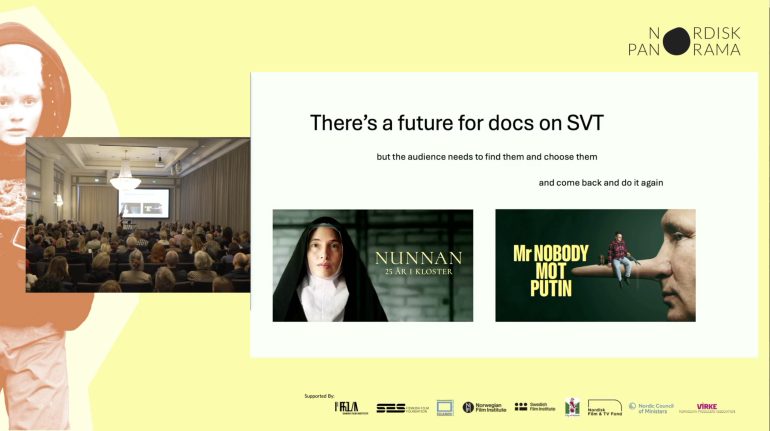
“I want to start on a sort of a hopeful note, because at SVT, we truly believe that here is a future for documentaries. They offer knowledge. They give us a more complex understanding of our world. And even though we’ve had to go through some pretty hard financial cuts, the documentary department was not too affected, so our budgets are more or less intact.”

“The great challenge for us who work with public service broadcasting is the public service value. And that value isn’t created by us financing a film or thinking that a film is fantastic, if nobody watches it. Public service happens when people watch films or programmes. Which makes it very difficult for us to balance the artistic ambitions and audience potential, because of course we also want to support the artistic films that may not get a great audience. But we also need the mega hits.”

×
NEWS

Navigating between art and attention: Where Is the Nordic documentary market heading?

Town Hall at Nordisk Panorama: Asta Dalman / Photo: Nordisk Panorama

Unlike many European broadcasters that have phased out linear strand identities, part of the SVT strategy had been to deliberately retain established strand brands – Dox for documentary features with the added slogan “The Best Documentaries in the World”, K Special for arts and culture, Dokument utifrån for current affairs – on the SVT Play on-demand service as trusted quality markers.

“It’s kind of interesting that we kept these brands. People look for them on SVT Play, they watch the films, and they know what they’ll get – it’s trustworthy. The Dox name, for those who know it, it’s a real quality marker. ‘Oh, this is a Dox film. Then I'm going to watch it, because it's going to be great.’ On the other hand, those who don't already know it will find it hard to understand what those films are about. But we keep it because at least it works for some. It doesn’t hurt.”

Dalman, too, had a chart of the top-viewed documentary titles at SVT. The “mega-hits” of 2025 and 2026 were, respectively, A New Kind of Wilderness and Mr. Nobody Against Putin.

“They both reached over 100,000. None of the others did. They are still films that we love, we think they are strong and really important for SVT as public service broadcaster. We support the Nordic film industry and the Nordic model. We would also love for more films to reach more people, and reach that mainstream potential without losing sight of the creative artistic qualities.”

A dilemma to which the fourth speaker had given some thoughts of a somewhat radical nature. John Webster, Finland-based independent writer-director-producer, has two Jussi awards and four filmmaking decades under his wing, and counting.

“I don’t think there is anybody here who is not painfully aware of how our audiences, especially young people, are moving online – increasingly to YouTube. This is not just a problem for broadcasters or cinema – it’s a challenge for all of us in our Nordic film community. Unfortunately, I don’t think we can build our future assuming that those audiences are going to come back. So instead of waiting for them to return to us, could we not go to where they are? To YouTube?”

Clearly addressing the younger segment of the audience, and that of the future, Webster still managed to include Charles Dickens, Alexandre Dumas and Fyodor Dostoevsky into the reach for that young audience, in need of an online strategy that would still include the crucial partnership between filmmakers, public funding, broadcasters and cinemas.

“There is a historical example, from the 19th century, which recently I have found quite inspiring. Many of the works we now think of as icons of literature — works by Dickens, Dumas, Dostoevsky and others — did not first meet their audiences as books. They appeared in newspapers and magazines, chapter after chapter, over months and sometimes years. That was where a huge reading public already was. And those serials had their own storytelling form.”

“And when the complete work was later published as a book, the serial had not made it redundant. Not at all. One built an audience relationship over time; the other offered the complete work in another form. That, to me, is an exciting parallel.”

Webster’s proposition involved that, rather than utilising platforms like YouTube purely as post-release marketing archives, there would be a recurring publishing of short-form narrative arcs derived from unused production footage during the shooting phase.

×
NEWS

Navigating between art and attention: Where Is the Nordic documentary market heading?

Town Hall at Nordisk Panorama: John Webster / Photo: Nordisk Panorama

”We would still do the principal filming before online publishing begins, but I don’t think it necessarily means longer shoots. A doc shoot already gives us far more material than a linear film can contain, and some of the wonderful darlings that we normally lose could instead find a place to deepen the online story.”

”I think there is a tremendous opportunity here. And there are already signs that audiences can move between these worlds — from online communities to cinema,” continued Webster, and mentioned projects like Denmark’s Project Iceman (2022), Finland’s Cancel (2025) and the US production Iron Lung (2026) as cases in point.

“But independent filmmakers cannot do this alone. Our funds need to support projects where online storytelling is designed from the beginning as part of the whole life of the film — and fund the extra editing and experimentation that it requires. Broadcasters and cinema distributors should not see audiences meeting the story online first as a threat. The film can still be exclusive. But with an added bonus: an audience that is waiting for it.”

“And perhaps this is also a space where generations can meet: younger online creators who understand how to build relationships with audiences, and established filmmakers who understand long-form storytelling. We have a great deal to learn from each other.”

Webster’s hypothesis certainly gathered most of the comments during the ensuing floor-session. The fact that Dickens had actually been paid was mentioned; expressions of scepticism and caution was aired, but there was also an appreciation for a fresh and inspiring take, very much aligned with the times.

As moderator Rishøj Jensen reluctantly yet contentedly closed the lively and invigorating session, his Kirkegaardian either/or question far from reaching a closure, at least no crew mates were sacrificed.

Final takeaways on the current direction of the Nordic documentary market, as per one quote per speaker, could be summed up like this:

Asta Dalman: “We support the Swedish documentary industry. We love it and we want it to thrive.”

John Webster: “The audience is moving, yes. If we go to them together, we may discover not just a new way of distributing documentaries, but a new way of telling them.”

Anders Bruus: “People should use the pause button, but the audience hasn’t found it yet. Like you can put down a long book in the middle of a long chapter.”

Cecilia Lidin: “I will admit that my reaction when I read the introduction to today's Town Hall was: ‘So what else is new?’.”

To this last point of view, Odysseus would heartily subscribe.

RELATED POSTS