Written by: Jan Lumholdt
22.06.26
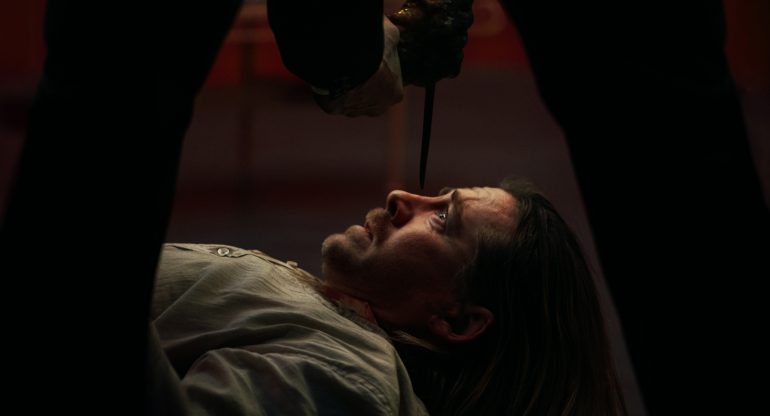
Some darker powers are at play up North at the moment, involving two national icons in rather unexpected guises… Or perhaps expected? Answers will be up on the screens soon.
Fårö is a small Swedish island in the Baltic Sea. Here, a young screenwriter has made a pilgrimage in order to meet his greatest role model and idol, who has sought seclusion on the island, creating his own fortress, most unwelcoming to any trespasser.
Admirers of European art cinema will soon deduct that this can be none other than Ingmar Bergman, one of the greatest filmmakers of the entire 20th century. The meeting between the young screenwriter and the great idol is depicted in a forthcoming fiction feature called The Cannibal (Kannibalen på Fårö), where nightmares are had and minds get lost, the film’s creators promise. The word “sacrilege” occurs in the description, as does “homage” and “meta cinema” – and not least “a totally genre-defying story about the possibilities and misadventures of filmmaking”.
It all stems from the pen of Peter Birro, himself a screenwriter, whose credits include The New Country (Det nya landet, 2000, co-written with Lukas Moodysson) and Easy Money II (Snabba cash II, 2012). His breakthrough came in 1997 with Hammarkullen, a colourful depiction of a Gothenburg suburb that promoted him to an instant force to count on. One singing his praise was the namesake of The Ingmar Bergman Award, of which Birro became a proud recipient.
“I got to meet him at his Fårö home. I also got to tell him that I, at the age of eight, snuck out of bed, hid behind a couch and watched a film that my parents had on, called Hour of the Wolf (Vargtimmen, 1968). Two things happened: I got scared out of my pants, and I got fascinated with cinema. Everything started right then, really.”
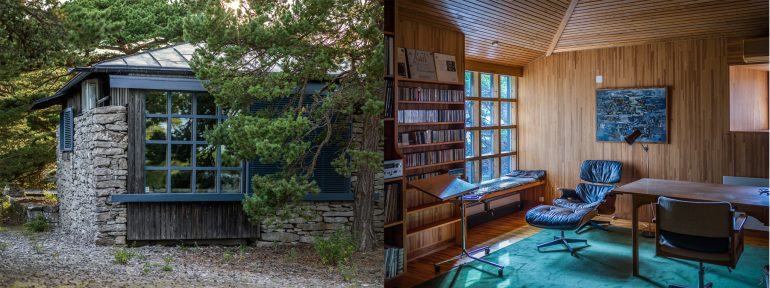
Bergman’s Fårö home is indeed the actual shooting location of The Cannibal, approved and sanctioned via The Bergman Estate of Fårö, the Norwegian foundation in charge of the premises. In his screenplay, Birro has chosen to view the place as both a haven and a Hades, that mythological underground world, gathering lost souls.
“He sometimes called it ‘a realm of death’, and that’s something I’ve worked into the story. Because Fårö isn’t just a geographic place, it’s also a mythical one, isn’t it?”
The main producer is Anagram’s Martin Persson, with Denmark’s Tall and Small and Finland’s Just Republic co-producing. The two main leads are Ardalan Esmaili as the young writer and Claes Ljungmark as the ominous title character, a part ever so briefly considered for Stellan Skarsgård, at least partly because his son Gustaf is directing the film.
“We had a small chat, but he felt he had done his deed, killing off the guy already,” acclaimed actor and soon feature debut director Skarsgård recounts, well aware of father Stellan’s frank dislike of Bergman’s bullying behaviour after working with him on stage in the 1980s.
“My father used Bergman to scare me when I was younger. I badly wanted to be an actor, but I was terrible at keeping times. And Dad used to say that ‘if you turn up just one minute late with Bergman, you’re sacked!’ He also advised me on his own method of coping with Bergman’s whims: ‘I look at him like a young and insecure kid, then I’ll get by.’ And that has followed me ever since.”
The exact amount of devoured meat, human or otherwise, in the film is yet to be disclosed, but everyone is clear on one fact: We all like to watch a really good villain, be it Darth Vader, Professor Moriarty, The Big Bad Wolf or… Ingmar Bergman.”
“Could he be the best baddie of them all?” wagers Birro, who obviously has put thought into the matter.
As a national brand, Bergman is top value, something that always arises interest. Birro concurs.
“Anyone will know, if nothing else, that he made some dark films on death and anxiety. And that’s why it’s intriguing to do a horror film on him, bringing in the demon side of things. It’s much more interesting than the biopic form, which anyway never scratches more than the surface.”
Meanwhile, in Norway, an equally larger-than-life Nordic “brand” artist is discovered in a document of dirty deeds, as yet another young writer is dragged into realms of madness. Vampyr, based on the 2016 novel by Steffen Kverneland and currently in post-production, places painter Edvard Munch in a malicious maelstrom of serial killings akin to Jack the Ripper. Pål Sverre Hagen stars alongside Ane Dahl Torp, Kristine Kujath Torp and others, Arild Fröhlich directs, and Maipo Film produces with Sweden’s Unlimited Stories in co-production. Maipo producer Cornelia Boysen promises “a unique, visual and surprising film”.
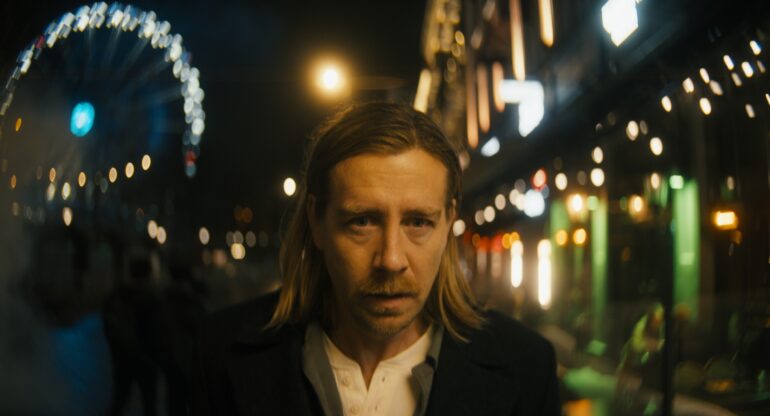
“We read the book when it came out, and immediately saw that this was something else. Arild Fröhlich was just as excited. What drew us in was an exciting and surprising story, set in a near-Gothic contemporary Oslo, and a playful plot and mystery. Not least, we loved the play with fiction and facts in the book.”
The notion of “re-framing” the world-renowned artist opened up for great opportunities.
“Precisely because Munch is Norway's most famous Norwegian, and one of the world's most famous artists, it makes it fun and exciting. We believe that even if we push the story way out there, we do it in a respectful way. Some will probably think the opposite, but we’ve had and have a good dialogue and cooperation with the Munch Museum in Oslo all the way.”
In other words, it’s allowed to treat Herr Munch in this fairly outrageous way?
“Here's the short answer: YES. Munch's art and the mystique surrounding him invite play, wonder and interpretation. And maybe we can manage to put Munch – if possible – even more on the map for new generations. We know that we had to check what was true and what was made up when we read the book, and we hope that this adds an extra layer to the film.”
The Cannibal and Vampyr both look at 2027 premieres, the latter already in February. Next week, Gustaf Skarsgård will guest the 2026 Bergman Week, playing out June 22-26, and do a deep dive stage talk on the project.
Always encouraging taste- and respectful storylines, Nordisk Film & TV Fond supports both projects. A possible merger sequel, “The Cannibal vs. The Vampire”, is currently not in the works. Any update on this matter will be reported on this page.
RELATED POST TO :
PRODUCTION
/
NORDIC INDUSTRY NEWS
/
NORWAY
& SWEDEN
& NORDICS