Written by: Ninna Bengtsson
19.08.26
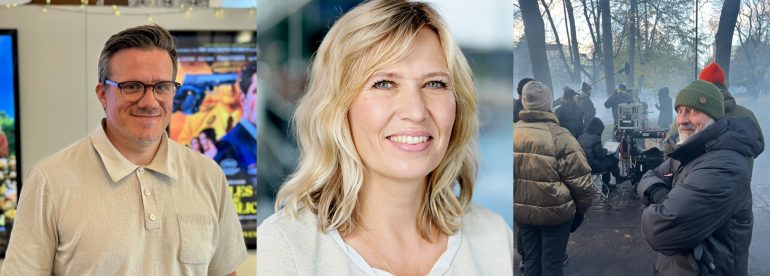
Film- and TV-producers face stress, unemployment and financial risk. As pressure mounts, calls for political recognition and sustainable conditions grow. Still, many call it the best job in the world.
From Odysseus and Growth of the Soil (Markens grøde) to Eagles of the Republic, every major film and television production relies on a producer. They carry much of the financial and administrative burden, yet often remain unseen in the shadows – unless their name is Jerry Bruckheimer or George Lucas.
In recent years, an already demanding job has grown tougher amid the streaming boom, pandemic, and increasing competition from new players such as YouTube and TikTok. Producers who spoke to Nordisk Film & TV Fond describe mounting stress, deteriorating working conditions, and commissioners demanding ever more for less.
“It’s a perfect storm. Things have just been getting worse and worse, and we’ve now reached a point where we’re seeing a great many production companies either going bankrupt or merging. We simply don’t have a sustainable business or financing model today,” says Emil Wiklund, CEO of Swedish production company Unlimited Stories, adding:
”Your options are to either make TV series and films for the streaming giants, or to rely on traditional models for theatrical films or co-productions with a broadcaster. Producers often invest their own money, and make big sacrifices to get projects off the ground, without getting anything in return.”
The growing pressure on production companies is being felt throughout the industry. A May Think Tank report by EAVE, the European development and networking organisation, highlights mounting mental and emotional strain among independent producers, with burnout rising rapidly. A January survey by Dansk Producerforbund, a new Danish trade union for film, TV and documentary producers, reached similar conclusions. Many of its 105 respondents reported insecure employment, heavy workloads, and budget cuts.
“There is an assumption that producers automatically own their companies and are therefore rich, but that’s not the case. Many are simply employees, like directors and screenwriters, but we do not receive any rights or royalties. Sometimes producers can be among the lowest paid, because we don’t have any additional income or agreements negotiated between unions and employers, about a minimum wage. Everything is negotiated from project to project, which makes you very vulnerable,” says Lea Løbger, producer and board member of the Danish Producers’ Union.
In an article in Danish publication Kulturmonitor, the union argues that development funding should include dedicated funds for producers, a clearer requirement for a lead producer on each project, and greater political recognition of the role.
“The survey confirmed that what we were all experiencing on a personal level is not an individual experience, but a structural issue. We have to find a new way of working. People are struggling to stay in the industry, because financing structures and business models are all changing so quickly,”
The EAVE report calls for instance on funders to protect producer fees, simplify reporting, set clearer professional boundaries, and provide more long-term support – recommendations that Lea Løbger strongly supports.
“We believe that funds should be specifically allocated in the budgets for the producer role, that would really help smaller production companies. We also feel that the job has become more complex, with administration, more surveys and paperwork, than when I started about twenty years ago. It should be recognised that it’s also a heavy task for producers to administrate.”
Finnish film and television producer Ilkka Matila, of MRP Matila Röhr Productions and the newly established Oy Saranne Ab, whose credits include The Eternal Road (Ikitie) and Mother of Mine (Äideistä parhain), describes a similarly climate in Finland. Major commissioners such as streamer Elisa Viihde have all but stopped commissioning new content, while cuts in funding have intensified competition for dwindling public funding, says Matila.
“All of these blows to the Finnish film industry have led to rising unemployment. Some companies have gone bankrupt, and overall, morale is not particularly high right now.”
Domestic films nevertheless retain a market share of approximately 25–30%, while box-office revenues have gradually returned to previous levels, partly because of higher ticket prices, according to Matila.
“The major challenge for the Finnish film industry is how we can continue to make films that appeal to our domestic audience and maintain the same market share and level of success we have achieved earlier. Feature film is a mass medium – something made for large audiences – but as audiences become increasingly fragmented, how do you make a film that appeals to everyone? It’s almost impossible,” he says, adding:
“From a producer’s perspective, the problem is that production has not become cheaper. The revenue needed to cover production costs is even higher now. In the past, a successful film might have attracted 200,000–300,000 cinema admissions, compared to 100,000–150,000 today. We cannot raise ticket prices enough to generate the revenue we need. Profitability is declining, and I see that as a challenge.”
Do producers receive enough recognition?
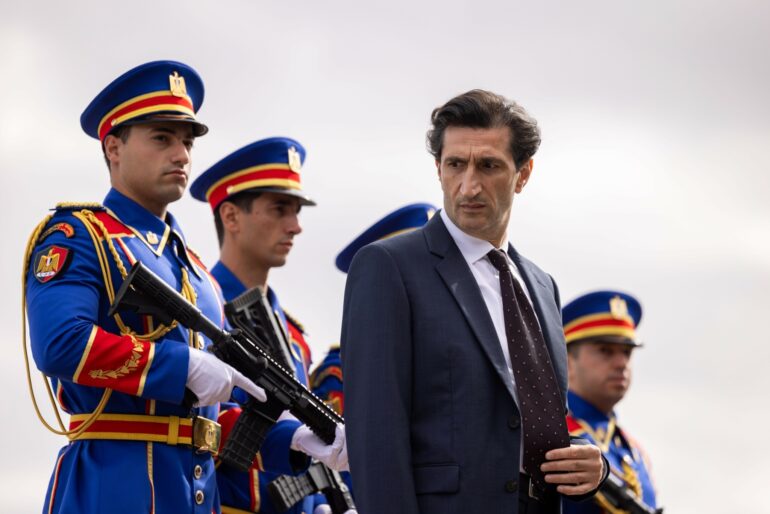
Swedish production company Unlimited Stories has titles such as Eagles of the Republic, Let It Rain (Regnmannen) and Hammarskjöld – Fight for Peace (Hammarskjöld) in its portfolio. CEO Emil Wiklund sees the producer as “the one who pushes the boundaries with commissioners”.
“I heard a Norwegian producer saying that 30 % of the job is being the audience’s advocate. It was incredibly insightful. Our job is to consider what audiences want, and shape the project accordingly. Commissioners often see themselves as representatives of the audience, but if they focus solely on existing viewers, they will make the same things all over again. We ask: Where is the audience right now? The producers drive the industry forward and determine which direction it takes.”
Job insecurity also contributes to stress. Unlimited Stories employs five full-time producers, but Emil Wiklund says the industry is increasingly moving towards a freelance model.
“Most production companies are laying off their producers and bringing them in for individual projects. It is extremely difficult to say what is right or wrong. We believe in employing producers full-time, because it results in better projects.”
Wiklund describes a turbulent climate. The sheer volume of content and competition from other platforms make films and TV series difficult to sell internationally. He also warns against relying too heavily on tech giants such as Netflix and Prime Video, which have invested in Scandinavian production, but could suddenly scale back their Nordic focus.
At the same time, commissioners are squeezing budgets.
“During the streaming boom, production costs rose dramatically, and they have not come down, even though production volumes have fallen. Commissioners are incredibly risk-averse, and everyone wants the same screenwriters, the same directors, the same actors. That creates a concentrated market, and drives their prices up even further.”
Many expect AI, particularly in visual effects (VFX), to bring down costs.
“We are certainly trying to stay at the forefront and explore different AI solutions, but the technology is not there yet. We are caught between a rock and a hard place: Commissioners want more for less, while suppliers say they cannot reduce costs any further.”
What would need to change to make producing a more sustainable profession?
“Recognition itself is not the most important thing for us; sustainability is. We are subcontractors to the companies that broadcast our content, yet there is little understanding of what we do or the conditions we operate under. We are treated a bit like a phone subscription whose price can simply be negotiated down – except here they are trying to drive down the cost of an entire production,” says Emil Wiklund.
He argues that greater understanding is needed of the immense personal commitment and financial risks involved in producing today.
Despite the uncertainty, Ilkka Matila cannot imagine working in another field.
“It is the best profession in the world. Every day is different and full of challenges and problems to solve. Nothing is easy; it is a profession in which you have to keep learning something new. Working practices, methods, people, and the market are constantly changing. Of course, it is mentally and physically demanding. But at the same time, you feel that you have an impact on other people’s lives,” Matila says.
Danish producer Lea Løbger sums up her advice to young people considering a career in producing:
“My first instinct would be to say: ‘Don’t do it.’ But of course, I am still here for a reason. Insist on good working conditions and basic human rights; they are just as important as the result itself. I think the younger generation is more concerned with protecting their mental health and looking after themselves. Of course, it is important to make your art and practise your craft – but not at any cost.”
RELATED POST TO :
PRODUCTION
/
NORDIC INDUSTRY NEWS
/
NORDICS