Written by: STEVE GRAVESTOCK
05.09.19
Exclusive: The senior programmer and Nordic specialist reviews for us the nine fiction films screening at the Toronto International Film Festival that opened on Thursday.
"This year in film the operative word, virtually across the board, has been trauma. It’s rare that I’ve seen so many films focused on people reeling from tragedy or disaster. It wasn’t only Nordic films either.
The Canadian features I saw – the other part of my programming job – were almost equally obsessed with tragedy, or at least our ham fisted, inadequate attempts to respond to it. (One could probably argue that the year’s biggest commercial hit, Avengers: End Game, was about dealing with trauma as well.) Even when it was profoundly personal, involving the loss of a loved one or a friend; a catastrophic medical diagnosis; the collapse of a person’s self-image; the loss of faith – these events seemed to occupy a larger, broader spectrum.
It’s tempting to draw any number of conclusions and look for causes, whether it’s angst about the climate crisis, melting glaciers, the rise of the far right, anti-immigrant sentiment or the collapse of the post World War II framework due to tantrums from an orange haired man child obsessed with buying Greenland, or the machinations of former secret police who like to be photographed shirtless on horseback. But the artists here are less concerned with polemics and politics, though considered altogether one gets a very clear and troubling picture of the zeitgeist.
This was particularly evident in two films about religion, or rather Christian cults: Zaida Bergroth’s Maria’s Paradise and Jorunn Myklebust Syversen’s Disco.
Based on actual events which took place a century ago, Bergroth’s MARIA’S PARADISE offers a disturbing look at a small but powerful Christian cult, led by Eino (Tommy Korpela) and the charismatic Maria Åkerblom (Pihla Viitala); it also lays out precisely how a cult works.
The leaders zero in on those in crisis, with a special focus on youth, many of whom have grown up in the cult, like the orphaned heroine Salome (Satu Tuuli Karhu). It and its teachings are literally all they know. At the same time, it’s increasingly clear that she holds sway over her acolytes because of her knowledge of worlds outside the cult. (It’s one of the reasons she can convince some of her young followers to attempt to assassinate a prosecutor who’s investigating the cult.)
The obvious one is her claim that she speaks directly to God, his angels, and spirits from the other side in her dreams – but for Salome it’s Maria’s knowledge of forbidden things - specifically sexuality - that matters. The biggest threat to Maria’s power world is the arrival of Salome’s friend, the worldly Malin (Saga Sarkola), someone who knows the outside world as well as Maria does. With its awareness of how cults work and how that kind of control can and inevitably will lead to violence, Maria’s Paradise holds up a not so distant mirror on contemporary culture.

It’s zealotry of a different kind in Syversen’s sharply observed DISCO, about Mirjam (Skam’s Josefine Frida Pettersen, who delivers an amazing turn), a contemporary teenager who has grown up in a family whose business is religion. Her stepfather is leader of a church and her maternal uncle is the leader of an even bigger institution.
And business is exactly what it’s about: privately, Mirjam’s stepfather talks more about earnings than Jesus.
The church’s faltering prospects cause friction between Mirjam’s parents – and Mirjam doesn’t understand why her stepdad is constantly chastising her for dressing too provocatively. He’s never complained about the highly revealing outfits she wears when she’s dancing competitively for the church. Their control of her is nearly totalitarian. She isn’t allowed to see anything, even in the virtual realm, which doesn’t bear her parents’ dogmatic seal of approval. Desperate, Mirjam turns to a more traditional sect, whose indoctrination methods may not be any better and might even be worse. Chillingly claustrophobic, Disco occupies a more microcosmic version of the world depicted in Maria’s Paradise, but it’s just as disturbing.

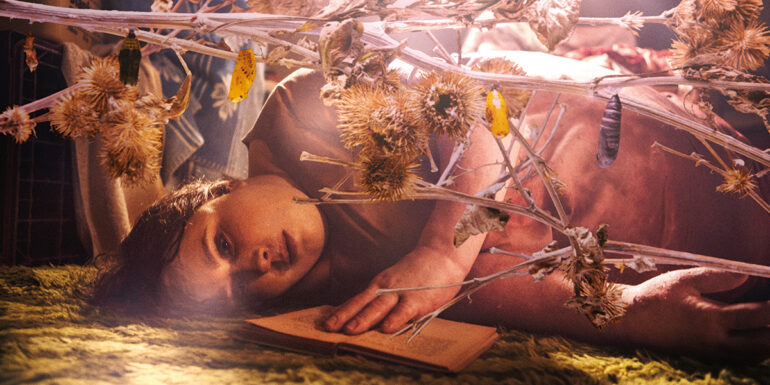
Control is similarly one of the principal subjects of Daniel Borgman’s superbly creepy RESIN, about a family of three, which has fled to a remote area on a sparsely populated Danish island, and refuses to have anything to do with the outside world. The father Jens chases off everyone who comes near their property and spends his days pontificating to his teenage daughter Liv about the wonders and genius of nature, and the twisted depravity of mainstream society in general.
But curiosity about the outside world proves stronger than his attempts at indoctrination. Liv’s night time “hunting trips” have turned into scavenging raids on nearby neighbours, including a bar owner who’s determined to find out what’s going on. In its tactile portrait of nature, odd sense of wonder and its undertones of folk and fairy tales, and its the transfixed, suffocating atmosphere, Resin recalls any number of genre bending films from the region -- like Border, They Have Escaped, Valley of Shadows, Burrowing, or All That Matters is Past – coupled with the ferocious paranoia and imminent menace of last year’s apocalyptic Aniara.
The hypnotic, transfixed mood is equally palpable in two of the biggest critical hits at the recent Cannes festival: Hlynur Pálmason’s A White, White Day and J.P. Valkeapää’s Dogs Don’t Wear Pants.
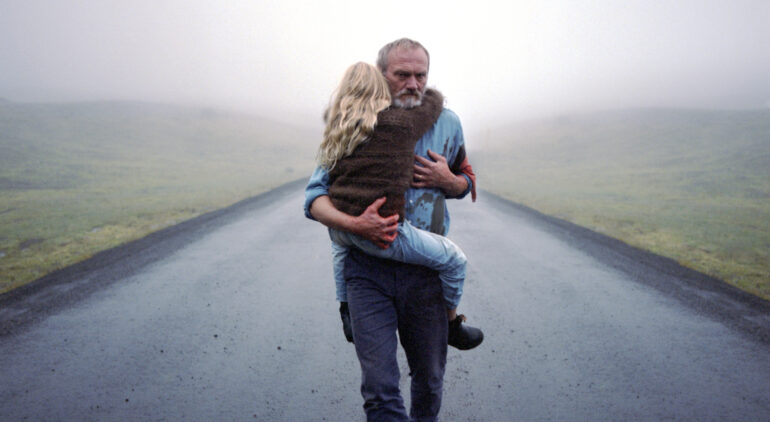
In A WHITE, WHITE DAY, a kind of Icelandic Affliction, Ingimundur (Ingvar E. Sigurðsson), a police officer living in a remote rural area, struggles to come to terms with the loss of his wife. On mandated leave, Ingimundur has little to do with his time but build, tear down and then rebuild the house they were going to retire in, and obsess about the circumstances of his wife’s death. As his loneliness, grief and need to find a reason for her death consume him, Ingimundur threatens to endanger himself and his grand daughter (the sole person he has any real connection with).
As distinct as Pálmason‘s spectacular debut Winter Brothers, A White, White Day is even more emotionally direct, powered by a stunning performance by Sigurðsson, who won a well deserved prize at Cannes (though it’s hard to understand how anyone could consider the star of Jar City emerging).
DOGS DON’T WEAR PANTS also deals with the loss of a loved one, but Juha (Pekka Strang) choses to respond to the loss of his wife in a very different way. Guilt ridden (he might have been able to prevent his wife’s accidental death), Juha is still struggling several years later, crying himself to sleep most nights. The only positive in his life is his daughter, Elli, now a tween. When he takes her to a piercing shop, he stumbles into a dominatrix’s dungeon and finds an outlet for his grief and guilt in Mona (Krista Kosonen) – and the abuse she metes out. But Mona quickly realises Juha’s death wish may be too intense for both of them to resist.
A study of grief that’s harrowing and sometimes absurdly funny (the fourth major character is the sound of Mona’s latex outfits squeaking ... loudly), Dogs Don’t Wear Pants suggests a In the Realm of the Senses minus the nihilism. (Or some of it anyway.) As Juha, Pekka Strang gives as complex and layered a performance as Sigurðsson.
Maria Sødahl’s Hope and Rojda Sekersöz’s My Life as a Comedian look at different types of trauma.
In HOPE, Anja (Andrea Bræin Hovig, one of Norway’s most skilled actors) is devastated when she’s told that the cancer she thought was in remission has returned – and in a more aggressive form. The diagnosis couldn’t have come at a worse time. Christmas is only a few days away, and Anja and her husband Tomas (Stellan Skarsgård) feel the need to tell the rest of their combined family, but there’s no doctor around to offer them anything like a prognosis.
Further complicating things is the pace of the life Anja has created for herself. A longtime superwoman, she’s always been able to care for her children, Tomas, and have her own successful career as a stage director, but the new diagnosis is forcing her to focus her life in ways which threaten her sense of herself. Faced with an existential crisis, Anja and Tomas are forced to decide what’s important and essential to them as they deal with an uncertain future and their responsibilities to those around them in a subtly directed and profoundly moving film.

Set in the 1970s, when Sweden was on top of the world (it was the era of Borg, ABBA and Olaf Palme), MY LIFE AS A COMEDIAN follows middle schooler Juha who is already leading several separate lives, each block off from the others by guilt and shame. (The film is based on Jonas Gardell’s classic, much beloved novel.) At school, he’s the class clown/outsider desperate for favour; at home he’s ashamed of his mother whom he considers too Finnish to introduce to the “Swedish” kids in his class; in the neighbourhood, he’s best buds with émigrés Thomas and Jenny Li, but because they’re “different” (Thomas is German and Jenny Chinese), although he never acknowledges them at school.
Told in guilt-ridden flashback by the adult Juha, now a successful stand-up known for his defence of the downtrodden, My Life as a Comedian painfully, heartbreakingly examines the cost of capitulating to social and peer pressure and prejudices.
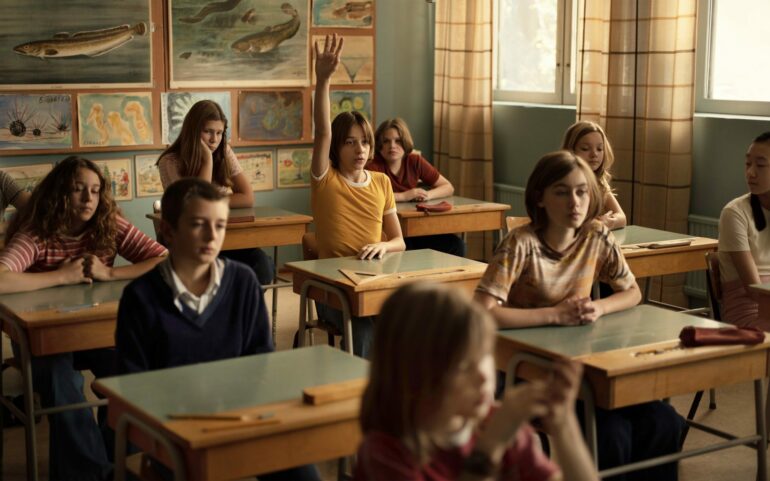
Grímur Hákonarson’s The County and Roy Andersson’s About Endlessness are perhaps paradoxically, the most optimistic films in this year’s TIFF selection of Nordic fiction features.
THE COUNTY examines the role of farming co-ops in Icelandic society, which though they started in response to Danish control of trade and were a key role in a fight for self-determination, eventually became as self-serving as the merchants who had a monopoly. Farmer Inga (Arndís Hrön Egilsdóttir, in a consistently engaging performance) knows nothing about the Co-op, but she does wonder why her husband Reynir refuses to buy supplies off other companies for a much cheaper price. When tragedy strikes, she’s forced to dig into her family’s finances and is confronted with the more sinister aspects of a monopoly. (A friend once referred to the Co-op as the Icelandic Mafia.)
A compelling drama which evokes films like Norma Rae, Country or Ravens in its emphasis on individuals against the system, The County is a worthy and sophisticated follow-up to Hákonarson’s Rams, propelled by the complex portrait of Inga, who’s driven to seek justice but is also conflicted, plagued by doubts if the farm Reynir devoted his life to is even viable anymore.
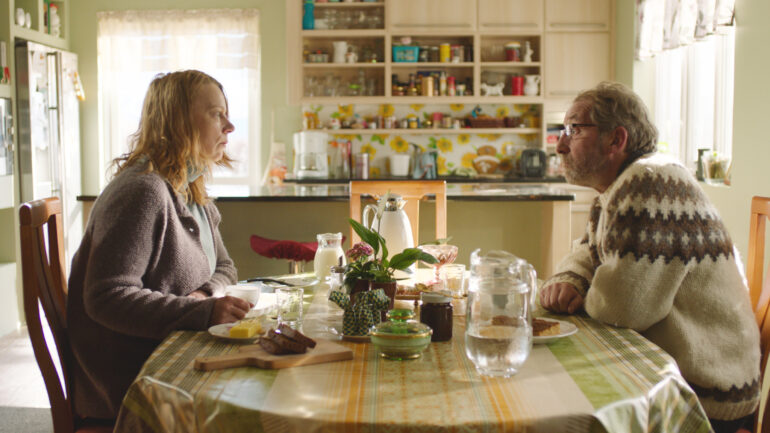
Finally, one of the most important and influential filmmakers of the last half-century, Roy Andersson, returns with ABOUT ENDLESSNESS, a drama which juxtaposes the epic with the quotidian.
Everyone in the film seems to be heading into a nightmare or waking from one. Yet Andersson seems intent on finding a means of understanding and empathising with his haunted characters whether they’re dealing with unfathomable tragedy (like the bombing of a city), personal catastrophe (a priest losing his faith), awkwardness (a tormented man on a crowded street-car), pounding rainstorms or a broken shoe.
In its implicit plea for empathy and (when necessary) outrage, and its implicit insistence on a sense of scale, About Endlessness is strangely one of the most optimistic films in the selection. That may sound ironic of course, given Andersson’s famous biting absurdist humour (he once ended a Q&A in Toronto with the observation that things wouldn’t end well for any of the people in attendance), but the film’s implied belief that human beings could find an appropriate way to respond to tragedies, large and small, seems oddly hopeful."
Steve Gravestock
RELATED POST TO :
FESTIVALS
/
NORDIC INDUSTRY NEWS
/
NORDICS