Written by: Davide Abbatescianni
03.08.26
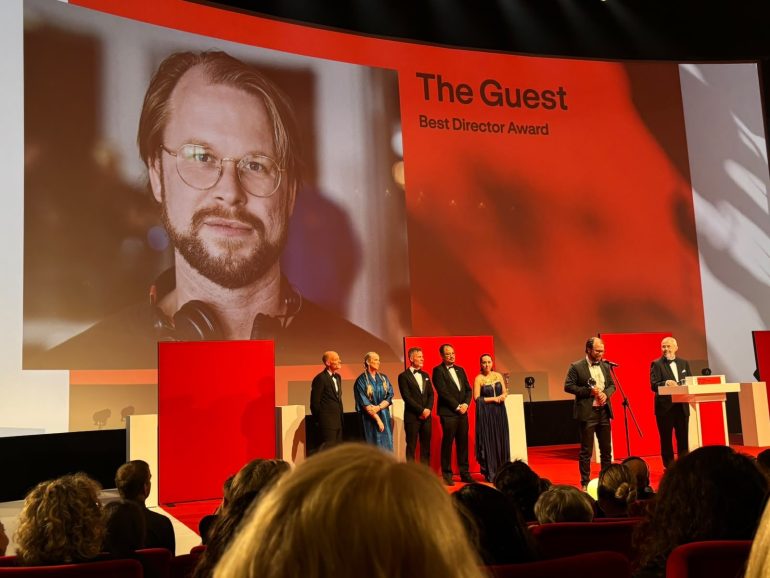
Mads Mengel's debut won two Crystal Globe prizes, while Swedish-Danish project Selamlik secured Karlovy Vary’s Eurimages development award.
At Karlovy Vary 2026, the Danish family drama The Guest (Gæsten) was the Crystal Globe Competition’s only double winner. Mads Mengel received the Best Director Award for his handling of the ensemble and tonal shifts, while the film landed the $15,000 Special Jury Prize. The jury called it a “squirmingly funny yet precisely modulated drama” exploring motherhood, filial duty and mental illness.
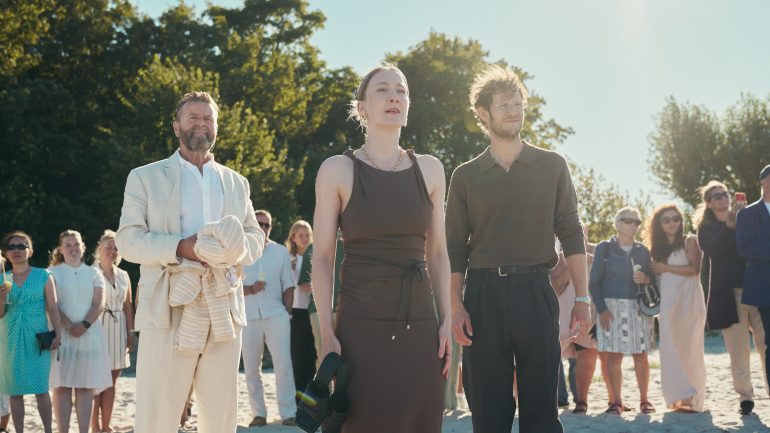
Written by Mengel himself with Christian Bengtson and produced by Victor Cunha for Monolit Film, it follows new parents Karl and Emilie, whose naming celebration at a seaside hotel is disrupted by Karl’s estranged mother, Vibeke. Trine Dyrholm, Simon Bennebjerg and Josephine Park head the cast. Scanbox holds Nordic distribution rights, DR is a partner, and LevelK handles international sales. Mengel and Cunha discussed the film with Nordisk Film & TV Fond.
What first led you to this story?
Mads Mengel: I knew I wanted to make something about family and the complexity of those relationships. Christian Bengtson and I talked about that a lot. A couple of years ago, my girlfriend invited me to stay at the hotel where the film takes place, around 40 minutes north of Copenhagen. I loved its hallways and atmosphere. Those images started the whole process.
How did you avoid defining Vibeke and the others as heroes or villains?
MM: We had rules: Characters could not tell each other things they would obviously know, and we avoided flashbacks. We had to convey the past through behaviour. We wanted nuance, with everyone at fault from time to time and the audience’s sympathies shifting.
You have described the film as being more about inheritance than mental illness.
MM: It is about inheritance and forgiveness most of all. Mental illness is an important part of it, but we also wanted to explore what connects us, how dynamics change over time, and what it takes to embrace forgiveness yourself.
How did the actors shape the film?
MM: We knew early that Simon Bennebjerg should play Karl, then Josephine Park joined, and eventually Trine Dyrholm said yes, which was tremendous for us. Christian and I like involving actors early, so we could write for them and invite their notes. Rehearsals revealed how physical the characters would be, how they interrupt one another, and the speed of the siblings’ exchanges. We also shot an 18-minute test around dinner scenes, which became a proof of concept. On set, I had clear intentions and the script had a clear structure, but the actors were free to follow their impulses within it. You could call it controlled improvisation.
Victor, how was the film financed?
Victor Cunha: Denmark has a talent-development scheme that gives new directors the opportunity to make a first feature. Around 80-90% of the financing came from that, although it is still competitive. The test showed the actors embodying the characters and helped Scanbox come aboard and complete the financing.
How did you approach the hotel visually?
MM: DoP David Bauer and I wanted to use as much of it as possible, creating visual diversity within a one-location concept. We decided early to shoot with a zoom and use crash zooms, giving the sense that the camera is breathing with the characters. You observe from afar without intruding on their private space; you are a guest to their family drama. Much of the lighting was natural. Bauer and gaffer Mikkel Sørensen followed a less-is-more approach that allowed us to shoot almost 360 degrees in every room while retaining a cinematic feel.
How did you approach the editing?
MM: I let editor Louis Emil Ramm Seeberg make the first rough cut and stayed away for about a month after the shoot. He showed us a two-and-a-half-hour version that was already a good beginning. We then worked intensively together for about three months, fine-tuning and cutting it down. We have collaborated many times, so I trust his taste and eye.
What makes the story specifically Danish?
MM: The family themes are universal, but Denmark has a tradition of big family gatherings and events. Danish society is also polite, perhaps too polite at times, so there is always a balance between what is said and what remains unsaid. We are restrained people – and then we explode!
What do you hope the film prompts audiences to discuss?
MM: I hope people take away that it is never too late to change dynamics; something that seems set in stone may not be. There could also be a conversation about how families deal with mental illness. Even with Denmark’s strong welfare system, I think we are still lacking when it comes to mental health. Both socially and within families, we do not quite know how to talk about it.
How has making your first feature changed you?
MM: It confirmed that the greatest decision a director makes is choosing the right people. I was not the smartest person in the room; everyone was an expert in their field, and I learnt from the crew and actors. It made me grow up as a filmmaker. I also became a father while we were writing and making the film, so that changed all of me.
Another Nordic win
Aung Phyoe’s Myanmar-Czech-French debut Fruit Gathering (Thit-thee Khu) scooped the coveted Crystal Globe, while Martina Buchelová’s Slovak-Czech pic Lover, Not a Fighter (Milovnik, nie bojovnik) took the Proxima Grand Prix. Anna Schinz and Ghassan Saad received the acting awards for A Happy Family and Pipes, respectively.
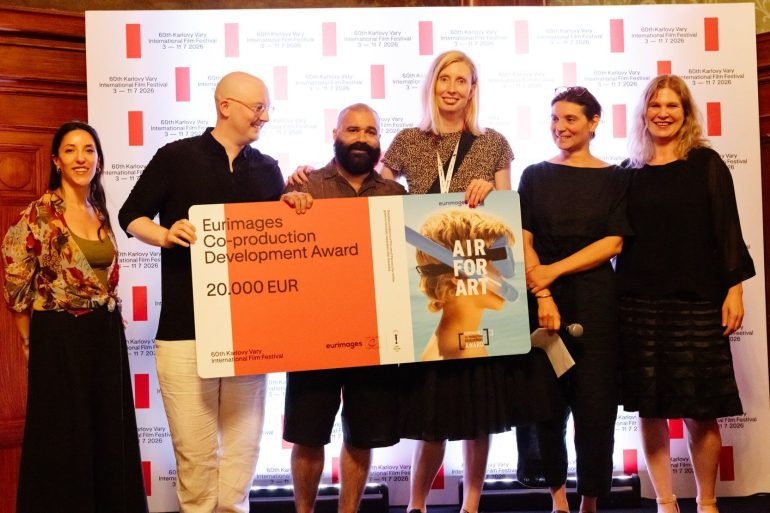
At KVIFF Promises, which presented 38 projects and IPs, Swedish-Danish project Selamlik received the €20,000 Eurimages Co-production Development Award. Selamlik is directed by Jerry Carlsson, penned by Khaled Alesmael and produced by Verket Produktion. The jury hailed the film as “a love story that the war made impossible”, moving between past and present and across countries both lost and rediscovered. It also highlighted its relevance to the current geopolitical landscape, particularly its exploration of displacement, and voiced hope that the prize would position Selamlik firmly within the European co-production arena.
This year’s KVIFF ran from July 3-11.
RELATED POST TO :
AWARDS
/
NORDIC INDUSTRY NEWS
/
INTERNATIONAL