Written by: Ulrik Bolt Jørgensen
22.05.26
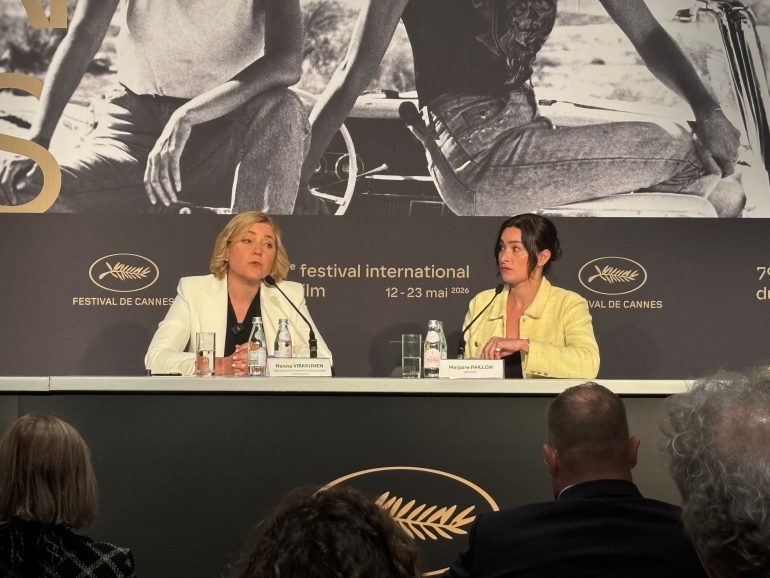
Report from a high-stakes fireside discussion with Finnish Henna Virkkunen, EU Executive Vice President for Tech Sovereignty, Security, and Democracy.
As the MEDIA programme celebrated its 35th anniversary in Cannes, a pivotal dialogue had emerged between the European Commission and the audiovisual industry. The major producer organisations have expressed deep concern regarding the removal of the term “independent production companies” from the new Agora EU legal basis, alongside the vanishing of the words "cinema" and "film" in favour of terminology focused on AI and big blockbusters.
Julie-Jeanne Régnault took the floor in the name of the European Producers Club and other European associations from the entire value chain and reminded EVP Virkkunen about the campaign “Europe Needs Cinema, Cinema Needs Europe” and the an open letter that was signed by more than 6,000 professionals, including Nordic talents Ruben Östlund, Juho Kuosmanen and Joachim Trier. She asked the EVP to reassure the sector that the MEDIA programme “as we know it supporting film and audiovisual" will be granted a dedicated budget and more resources. She also mentioned the need to continue to support independent producers as well as cinemas, theatrical distribution, festivals and trainings, all at the heart of the MEDIA success story.
Legal advisor Charlotte Lund Thomsen, who represents both Nordic and international producer associations, highlights that the structural changes are equally alarming. "We are not happy with being grouped in the same structure as news and press," Thomsen stated, noting that while those sectors deserve support, they should not share the same budget line. She warned that under the current proposal, if global developments require more funding for journalism, "those funds would then have to be taken from us".


The fight for a definition: "Business and legal certainty"
A central point of contention is the Commission's desire for more "room to maneuver" by not including a fixed definition of a independent production company in the new regulation. Thomsen argues this is a direct threat to the industry's stability. "It is absolutely central for us...that the definition from the current MEDIA programme is continued," she explained. Without this, she argues, it is impossible for a company to have "business and legal certainty*"* when forecasting projects that take years to finance and develop.
Virkkunen: Scaling up vs. the "European giants"
In response to industry fears, Virkkunen asserted that culture is a "basis for our democracy, security, and resilience", and confirmed a proposed 8.5 billion Euro instrument for 2028-2034. She argued that the new structure offers the "flexibility" needed to face global challenges and the dominance of big tech.
However, Thomsen countered that the Commission's underlying goal appears to be creating what Virkunen calls "European giants" - large, major production groups. For small markets like Denmark, Sweden, and Finland, Thomsen warns this strategy is "really dangerous", because these giants are unlikely to emerge from smaller territories. If the EU prioritises these majors, she argues, "our member states are the ones who will have to pick up the pieces and try to create balance again, and they cannot do that."
The Nordic perspective: Creative courage over blockbusters
The discussion highlighted a fundamental disagreement on strategy. While Virkkunen speaks of "scaling" and "harmonisation”, the Nordic model remains rooted in "wild ideas" and the "creative courage" to produce original works that might otherwise be lost in a survival-of-the-fittest scenario. Independent producers are viewed as vital contributors to democracy through a unique perspective that cannot be replaced by "blockbuster ideology".
Looking ahead
While Virkkunen acknowledged the "very strong message" from the industry's open letter, the battle over the Agora EU budget and its specific "envelopes" will continue in the European Parliament through the autumn. As Régnault noted, the risk remains that without specific protections and dedicated budgets for the independent sector, European stories will increasingly be controlled by global giants, turning "film" into a mere "tech product".
To the letter: CLICK HERE.
To the joint statement: CLICK HERE.
RELATED POST TO :
FESTIVALS
/
NORDIC INDUSTRY NEWS
/
INTERNATIONAL