Written by: Ulrik Bolt Jørgensen
16.02.26
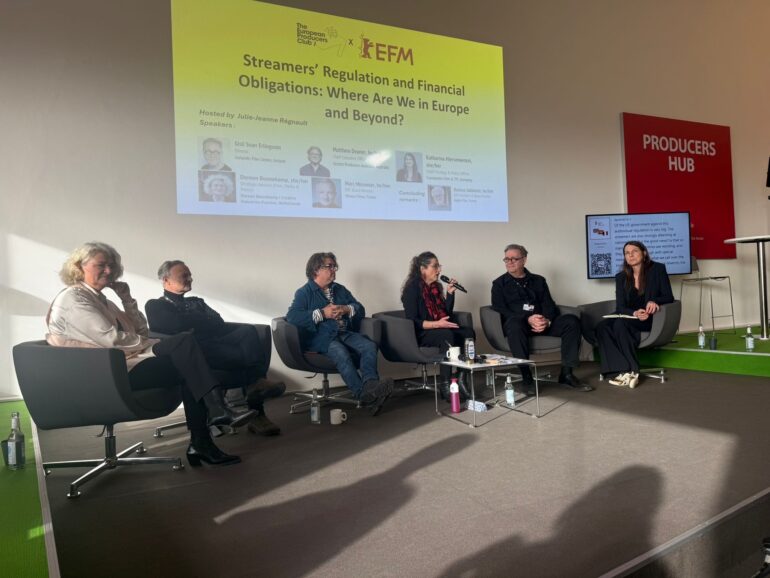
Berlin panel report: Cultural Sovereignty and the new frontier of streaming regulation.
At a high-level panel during the European Film Market (EFM) in Berlin on Sunday, February 15th, the European Producers Club (EPC) gathered experts to discuss a pivotal moment in global media policy: "Streamers’ Regulation and Financial Obligations. The consensus was clear - these financial obligations are no longer just economic measures; they are essential tools to protect cultural sovereignty and independence in the face of global streaming dominance.
By mandating that global platforms reinvest in local stories, nations are asserting that their cultural identities are not merely commodities, but public goods that require protection to ensure a diverse ecosystem.
The Nordic Front: Progress and Setbacks
The Nordic region continues to be a central battleground for these regulations, with significant updates shared during the panel:
- Denmark Leading the Way: Denmark has moved past the discussion phase, with its cultural levy fully operational as of January 1, 2025. Streamers must pay a basic 2% levy on their Danish turnover. However, if a service fails to invest at least 5% in local content, the levy increases to a total of 5%. This scheme is expected to generate approximately 100 million DKK annually (13.5 M EUR), with 80% specifically earmarked for Danish films.
- Norway’s 4% Mandate: Norway has also moved into a new phase after the Storting (Parliament) adopted amendments to the Broadcasting Act in February 2025. The new law imposes streamers to invest at least 4% of their annual revenue in Norwegian-language audiovisual works. If they don't meet this requirement, they will need to contribute to the Norwegian Film Fund, with contributions potentially reaching up to 5% of their revenue. As of February 2026, the government is finalising detailed implementing rules regarding reporting and enforcement.
- Iceland’s Last-Minute Twist: Iceland’s journey toward a 5% contribution model - intended to protect the Icelandic language and provide "top-up" funding for TV series - hit a sudden hurdle. Just days before the Berlin panel, the Icelandic government pulled the bill for further amendments. While the industry remains hopeful this is a technical tweak, the delay highlights the intense pressure surrounding these legislative processes.
The German Benchmark: A New Entry Level
The panel highlighted Germany’s recent political agreement as a vital benchmark for other nations. Germany has established an 8% direct investment obligation, with strict sub-quotas: 70% must go to independent producers, and 80% must be in the German language.
Crucially, the German model also includes a "theatrical factor”, where investments in cinema films count as 1.5% toward the obligation, incentivising streamers to support the big screen.
Red Lines: Key Negotiation Points
The EPC and panel speakers outlined some-negotiable points to ensure these regulations effectively support local ecosystems including:
- Rights Retention: This is the "heart of the battle". Following the French and German examples, producers must retain intellectual property (IP) rights. In Germany, rights will revert to producers after 3 to 7 years, depending on the level of independent financing.
- Supporting cultural audiovisual creation: Revenues must be directed toward independent cinema, documentaries, TV series, and animation. Stakeholders emphasized that "cultural production" must exclude sports, reality TV, cooking shows, and light entertainment, which do not contribute to long-term cultural heritage.
Speakers also insisted on window releases Regulations must be tied to a stable media chronology. In France, for example, the level of investment is linked to how soon a streamer can show a film after its theatrical release. Protecting these windows is vital to the entire film financing system.
As the panel concluded, these regulations represent a "revolution" in protecting freedom of expression and the sustainability of medium-sized creative enterprises across Europe and beyond.
Link to the panel: CLICK HERE.
RELATED POST TO :
/
NORDIC INDUSTRY NEWS
/
NORDICS
& INTERNATIONAL