Written by: Ninna Bengtsson
19.10.26

As the global television business navigates consolidation, advertising-led streaming, new distribution platforms and the disruptive potential of artificial intelligence, industry executives gathered in Cannes to assess what comes next.
“It is very clear that AI is the new Cold War. It’s a Cold War between China and the USA. This technology is going to drive not just our industry, but every industry over the next ten or twenty years,” says Guy Bisson, Research Director and co-founder of Ampere Analysis, speaking to Nordisk Film & TV Fond.
Cannes may have looked sunny, with palm trees lining the Croisette beside the Palais des Festivals, where MIPCOM took place this week. But behind the glossy facade, dark clouds were gathering, and the TV industry was facing a storm.
Market turbulence is intensifying, with continued corporate consolidation, a growing focus on advertising revenues and branded content, and increasing competition from YouTube, TikTok and similar platforms. Many companies are facing strong headwinds, and collaboration with brands or streamers is increasingly seen as part of the solution. Some 10,100 delegates from 104 countries gathered at MIPCOM in Cannes, the world’s largest TV market, during the week – approximately 500 fewer than the previous year.
One of the Nordic attendees was Mikael Österby from the Swedish public broadcaster SVT.
“It’s an exciting and strange atmosphere here at MIPCOM this year. There is a lot of talk about the major corporate consolidations and mergers that have taken place over the past year, a lot of money, and many people and projects changing places. It’s exciting, but also sometimes difficult to know how, as a buyer or commissioner, to plug into the deal,” he says.
He sees some trends in factual and documentary programming, with many AI-generated programmes in the pipeline, as well as micro-series in factual content.
“The big public service broadcasters, such as ZDF, the BBC and France Télévisions, have changed their digital strategies, what they get involved in and how they finance projects, more in line with what SVT is looking for, and that is good. There is money and things are happening, but what creates uncertainty is how to reach the audience.”
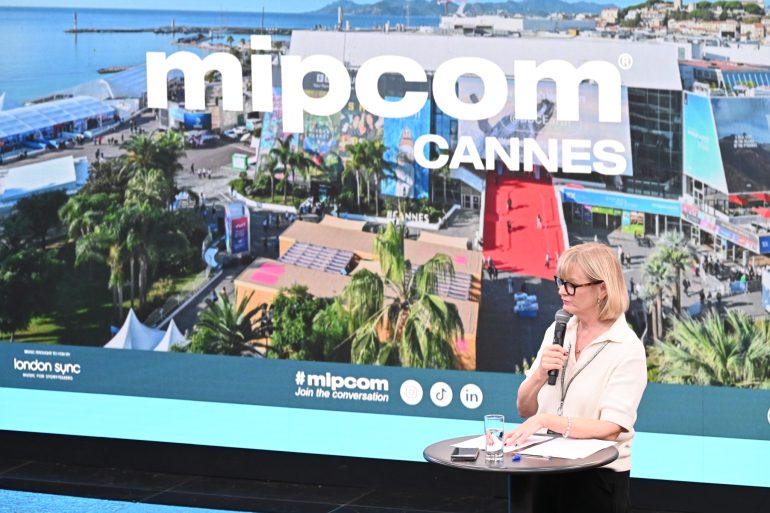
Lucy Smith, Director of MIPCOM at RX France, summed up the situation at a press conference on Wednesday.
“Consolidation is reshaping the traditional entertainment landscape. At the same time, we’re seeing creators, brands, technology companies and digital platforms becoming key actors in the content economy, bringing new sources of entertainment, investment, new audiences and new ways of doing business. Vertical storytelling and microdramas are challenging the established formats, while AI is changing how content is made.”
At the same time, advertising has become the main growth engine for streaming. It affects which genres are commissioned, how much local content is produced, how series are released, and how platforms retain audiences, according to Guy Bisson at Ampere Analysis.
Ruth Berry, President of Global Partnerships & Zoo 55 at ITV Studios, highlights growing competition for attention, the challenge of discoverability and changing revenue models. She also sees renewed interest in sports and live events – content that gives people a reason to watch together.
“All commercial broadcasters have got to be thinking about how they win audiences and the attention of the advertisers. Everyone is now putting advertising on their platforms, so that is becoming a really big thing for our industry.”
And scale really does matter.
“One of the key drivers in the industry is the ongoing need and desire for scale. That is happening across all sectors, from production to distribution to streaming to legacy media, pay TV and traditional broadcasters as well. All of that is a reflection of the changed demand in the market, the shifting competitive landscape, and the rise of competition that has become more and more direct in the form of social media,” says Guy Bisson.
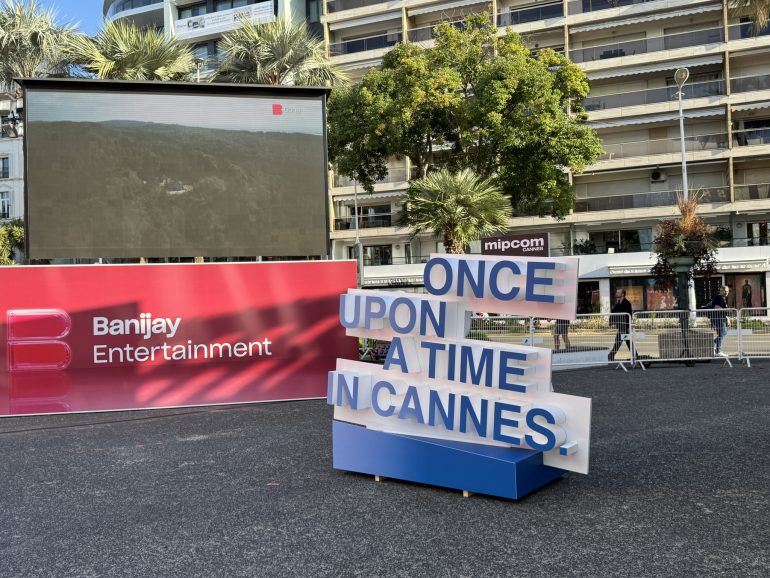
The trend is reflected in a wave of major deals: Skydance’s acquisition of Warner Bros. Discovery, Fox’s agreement to buy Roku, Sky’s planned purchase of ITV’s broadcasting and streaming business, and the roughly $8 billion Banijay Entertainment–All3Media merger.
“It’s not about more muscle in the market; it’s about combining our geography, our scale and our diversity. I think it’s a very smart merger, because All3Media is predominantly a UK and US production outfit. Obviously, it doesn’t have a production footprint in the Nordics, so I think the scale there is really clearly evident,” says Lucas Green, Chief Content Officer at Banijay Entertainment.
Lucas Green believes viewers still want stories, settings and people that feel local, even as format buyers care less about where ideas originate. He points to two successful formats – Sweden’s 100 Knives (100 Knivar) and Nordisk Film TV’s Date Knight – as examples.
“The ability to use the bigger geography of Banijay and All3Media combined will be a huge benefit in terms of exporting original and existing Nordic IP,” says Green.
Andreas Hjertø, head of Pilar Media, a newly founded Norwegian company whose platform connects producers with buyers of finished content, was in Cannes, and sounded positive about the market.
“Above all, I have been encouraged by the breadth of demand. In conversations with buyers, there is both money and a willingness to buy. This applies to both new, exclusive productions and larger catalogue deals. That doesn’t mean financing is easy, but the market is not as stagnant as one might sometimes get the impression of, and co-productions keep coming up.”
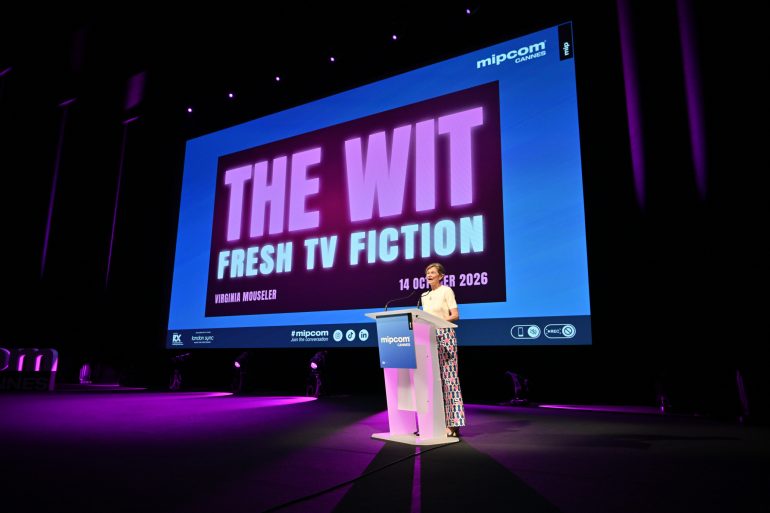
Nordic productions attracted considerable interest at the market. One example was the Swedish-German co-production Queen Silvia, which had its world premiere and tells the story of how Silvia and Carl Gustaf met at the 1972 Olympic Games in Munich. Several Nordic titles were also featured during a presentation by the research company The Wit on some of the world’s standout TV series: Rivals (Rivalerne, TV 2 Denmark), Summer of 1985 (Svärtan, SVT), Diagnoses (Diagnoser, SVT) and The Traitor Within (Rinnan, Prime Video/TV 2 Norway).
Among the trends in scripted programming is a growing appetite for book adaptations, which have increased by 15 % over the past five years compared with 2016–2021. Scripted productions based on true crime have seen an explosive increase of 150 % over the same period, according to The Wit CEO Virginia Mouseler.
“I always think of the Nordics as being very innovative and entrepreneurial. And of course they are always ahead of the curve on the digital side. We distribute a lot of Scandinavian programmes around the world that are bought by broadcasters, for instance in Australia and the USA. It’s important that we export great stories from around the world, wherever they come from,” ITV’s Ruth Berry tells NFTVF.
Children’s content is shifting towards YouTube and social media-inspired storytelling as traditional commissions decline, according to research presented at MIPJunior ahead of MIPCOM. Music, friendship, sport and animals remain popular themes.
Finland’s Yle and Belgium’s VRT Ketnet also initiated a meeting of more than 20 public broadcasters, with Norway’s NRK and Icelandic RÚV among the announced participants, to explore animation partnerships amid growing financing pressures.
The big talking point at MIPCOM was, of course, AI, with various panels, industry discussions and a keynote from Utopai. In China, 74 per cent of vertical dramas are now made using AI, according to a panel hosted by Chinese drama producer and distributor Huanyu Entertainment. Discussions at the special MIP Entertainment Forum covered everything from production and dubbing to content discovery and licensing catalogues for AI training, alongside questions about ownership, consent and the value of creative work.
Major technology companies are investing both in their own systems and in smaller AI companies. The creator economy and microdramas may be disrupted first because content can be produced rapidly and markets can be flooded, says Guy Bisson of Ampere Analysis.
Andy Fry, a reporter for MIPCOM Daily News, summarised it during a closing session:
“Some producers are making a lot of money just by digging up all of their old stuff, things that haven’t had any TV value for a long time, giving it to an AI company just to train. So ethically, you have to make a decision about whether you want to do that or not.”
“It's a tool, and it's not going anywhere.”
RELATED POST TO :
BUSINESS & SALES
& FESTIVALS
/
NORDIC INDUSTRY NEWS
/
INTERNATIONAL