Written by: Jan Lumholdt
06.02.26
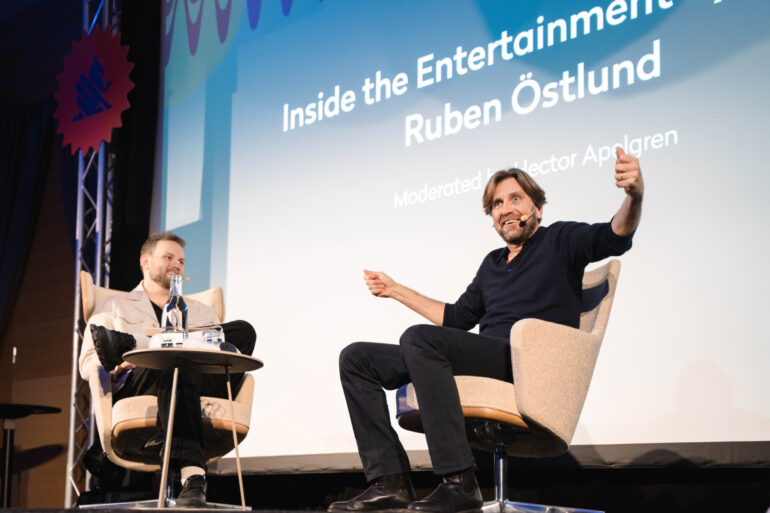
During a post-production break, Ruben Östlund took the stage at the Göteborg Film Festival to bring some insights into his upcoming film The Entertainment System is Down.
“I did a lot of promotion in 2017, and travelled quite a bit. On a long-haul flight over the Atlantic, my wife said that it would be interesting if the screens stopped working mid-air in this day and age when we’re all constantly and completely absorbed in them. Right then the title came to me.”
Seven years later, a special showcase titled “Inside the Entertainment System” was presented at the Göteborg Film Festival by its own Honorary President Ruben Östlund, who took the stage for assorted insights into The Entertainment System is Down, currently in post-production. Like for each of his recent suite of world cinema auteur hits Force Majeure(Turist, 2014), The Square (2017) and Triangle of Sadness (2022), spring season Cannes is the venue for unveiling. That being said, the wintertime Göteborg audience almost got a preview already now, despite not being shown a single frame, but from the illustrious presenter, never the shy one, and not shying away from giving away some major plot twists.
Back to 2017, and the next step in the signature Östlund method: stealing.
“Straight away, I started mentioning my forthcoming film to the journalists during interviews, as I’ve done with all my recent ones. When you present a setup that’s fairly strong, people start throwing ideas back at you. They’ll say ‘Hey, you know what – I’ve experienced this too’, and then they tell you. Some of the ideas are great. I steal them immediately, without asking for permission.”
Sociology plays a main role, and experiments can be inspiring.
“I often look at the sociological aspects and try to find studies on them. Here I found one so perfect I even shot it: ‘Just think: The challenges of the disengaged mind’, led by psychologists at the University of Virginia and Harvard University in 2014. The challenge basically lies in being bored. They asked people to go sit on a chair and do nothing for between 7 and 15 minutes, without having track of time. They soon found out that people feel stressed and restless, and some even compared it to torture. Only 15 minutes, mind you, and all age groups were equally affected. We humans simply don’t like doing nothing, that’s a fundamental state.”
In the film, this challenge will be seen through the eyes of a young girl, waiting for her turn to use an iPad.
“These two kid sisters are fighting over an iPad that still has a little battery left. Their dad decides that they have to take turns, with 15 minutes per turn. We then get to see the sister who has to wait – in real time. I’m very curious about the audience reaction. The distributors are nervous. To me, it’s the best selling point. What if I’ll create the biggest walk-out in Cannes history?!”
Östlund then ventured into the setting, often a character of its own in his universe. This time more than ever, by the sound of things.
“In Triangle of Sadness, I had three attractive settings: the fashion world, the luxury cruiser, and the paradise island. Here, I wanted a new challenge, one that worked perfectly with the idea: one single setting, the plane. It’s really tough. I’ve watched many airplane films. Very few of them are good. As soon as you try to create a dynamic, you hit a block.”
He soon realised he needed an entire airplane.
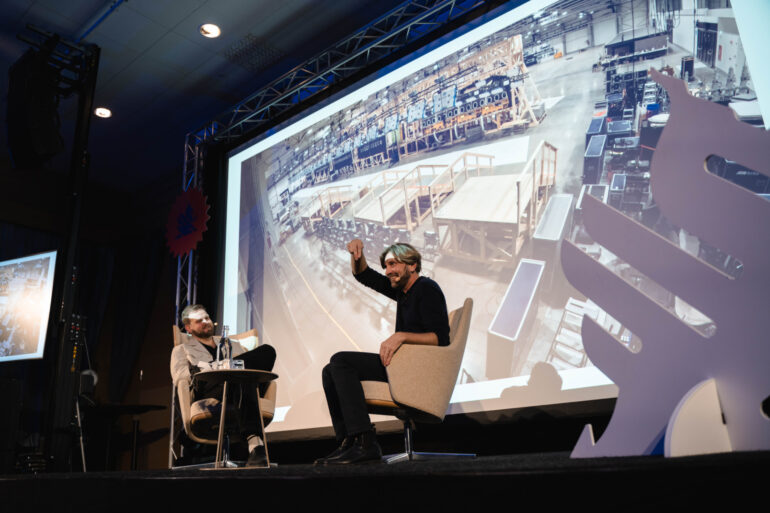
“It was important to me to be able to walk all the way from the cockpit to the rear economy and to turn the camera in whatever way I wanted. In other airplane films they’re often limited to some corner or some windows or the likes, it gets very confined. Not here.“
He then went out and got himself a Jumbo Jet.
“The beautiful thing after a film like The Square or Triangle of Sadness is that you can get pretty good financing. And here, we needed to buy a Jumbo Jet. A little less than a year before shooting, we’d bought a grounded Boeing 747. They’re not super expensive, but still quite costly.”
The plane was moved to and assembled in the Budapest studio where the film is shot. According to Östlund’s vision of authenticity, the correct number of passengers had to be visible.
“The airplane has 295 seats, and there are 295 passengers. The visual language here is a sharp cinematography where you will see everyone, from cockpit to rear economy, equally sharp.”
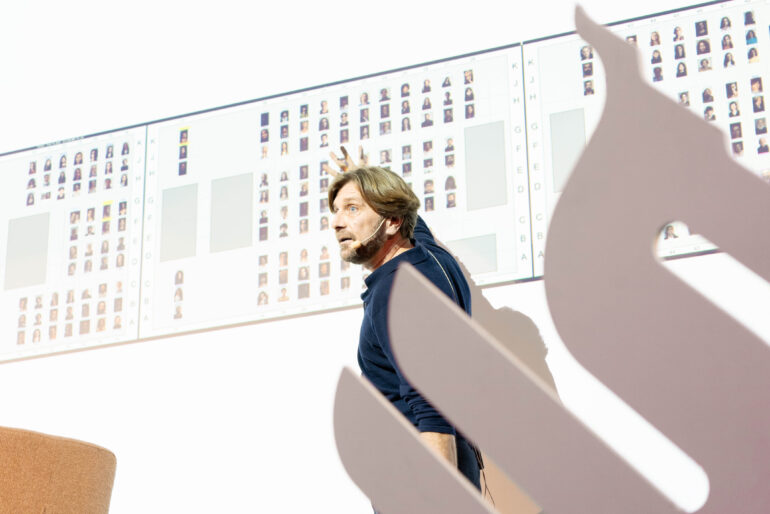
“So the plane had to be full. Even if you shoot a simple dialogue scene, you need at least some 150 people. We soon realised that basically the entire shoot would need a lot of people that would have to be on the set every single day. We spent about 70 days shooting in the airplane, and many people were there for at least 50 days. In the end, we had about 1,000 people on a waiting list, because we realised that every day was going to be different as far as angles and such.”
Some leading cast names include Sanjeev Bhaskar as the captain, Nicholas Braun and Julie Delpy as co-pilots, Daniel Brühl as the dad with the two fighting daughters, Kirsten Dunst as Brühl’s girlfriend, and Keanu Reeves as an electrician who may even fix the entertainment system. Apart from boredom, there will be infidelity, fighting, quality socialising, a heart attack, and eventually an ending, described by Östlund in vivid detail at the presentation. A plot point he’s especially pleased with is the compensation for the broken system offered by the airline: a bottle of water and a cheese sandwich. Which is taken with offense by some passengers.
A prominent Östlund trade mark is the at times intense moments of embarrassment, losing face, shame, and related forms of human discomfort.
“Personally, I get a relief when dealing with shame and painful feelings on the screen, as I’m terrified of those feelings in my real life. I think we can get the same effect we get from watching violence in the cinema – we get the adrenaline rush, but we don’t have to experience it ourselves. We love to look at a conflict on the screen – we feel alive, but we’re not actually there.”
The premiere will be confirmed later this month.
“There are times when things change as new and great ideas turn up late in the process, which has happened here. At the end of February we’ll decide if it will premiere in 2026 or in 2027.”
Update: On March 11th, Östlund announced that a 2026 premiere would no longer be an option, partly, reportedly, because of the challenges of the above-mentioned 15-minute ”iPad scene". In his quest for the perfect edit, Östlund plans to hold a number of test screenings, starting June this summer.
RELATED POST TO :
PRODUCTION
/
NORDIC INDUSTRY NEWS
/
SWEDEN