Written by: Davide Abbatescianni
19.08.26
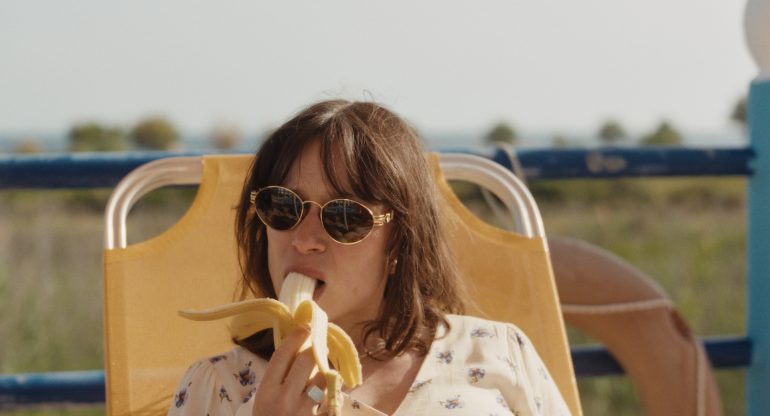
From Maria Bäck’s norm-defying Brave New Love to new projects seeking partners at Locarno Pro, Nordic filmmakers made a striking impression on the Swiss gathering.
The 79th Locarno Film Festival closed on August 15 with Romanian director Florin Șerban’s You Don’t Belong Here (Nu e locul tau aici) taking the coveted Golden Leopard. The Nordic presence nevertheless stood out across the gathering and its industry sidebar, led by Maria Bäck’s Danish-Swedish-Greek Brave New Love (Fagre nye kærlighed), which world-premiered in the International Competition on August 9. Although it left without a prize, the film drew an enthusiastic critical response: Variety hailed it as an “unusual, open-minded marital drama”, whilst Cineuropa praised its “edgy humour and anti-normative impulse”.
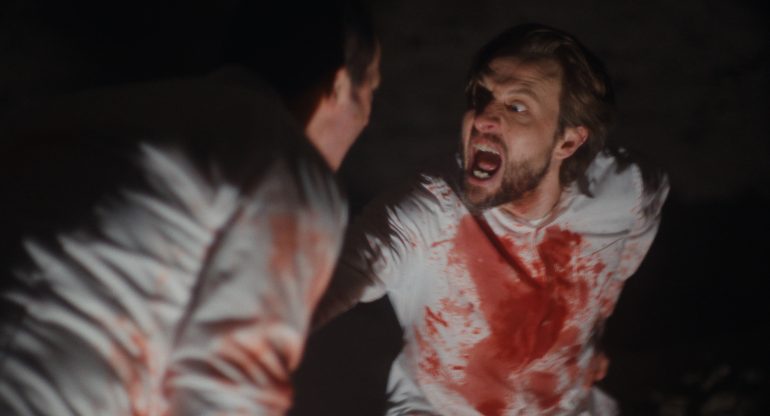
The pic follows hypnotherapist Kate (Kathrine Thorborg Johansen), whose secret relationship with Andreas (Anders Danielsen Lie) unsettles her marriage to Orla (Simon Sears) and forces her to confront ideas about love, motherhood and shame. Nordisk Film & TV Fond spoke to Bäck and lead producer Anna-Maria Kantarius in Locarno.
Where did this story about infidelity and identity begin?
Maria Bäck: I have been interested in norms since childhood, even before I knew the word: What is normal, what is a shared reality, and what is private. I have also struggled with questions around love for 30 years. Kate first came to me as an image, and became a way of telling a story from things I had collected over many years.
She was a hypnotherapist from very early on. I have tried hypnosis many times, and I also had an image of a therapist who begins crying while helping a client. I knew that scene belonged in the film.
How did you avoid judging Kate and the other characters?
Bäck:Everything you write forces you to confront something in yourself. I had to confront my own shame and vulnerability. I try to meet every character as if they were my best friend. Judgement appears when you do not enter somebody’s inner life; if we understand that inner world, we can have empathy with almost anyone.
We created reference groups, including one connected to the church and the Circle of Shame. I would almost play Kate and tell her story, testing when to reveal certain things and observing people’s reactions. Some lines came directly from those discussions. We also asked what an audience would expect to happen, and often tried to do the opposite.
How was the co-production assembled?
Anna-Maria Kantarius: This is our third production together. Our previous films were Swedish-majority productions, but Maria has lived in Denmark for more than 20 years, and we both trained at the National Film School of Denmark, so we felt it was time to make a Danish film.
I am based in Stockholm and work for Garagefilm, but I produced this film through Snowglobe, a natural partner after we had co-produced Godland (Vanskabte Land) and Suicide Tourist (Selvmordsturisten) with them. Garagefilm became the Swedish co-producer. Konstantinos Vassilaros at StudioBauhaus read the script on a flight, landed, met us, and came on board as the Greek co-producer. We shot for six weeks: four in Aarhus and two on Samos.
The Danish Film Institute, West Danish Film Fund, TV 2 and REinvent backed the Danish side; the Swedish Film Institute and Film Stockholm supported the Swedish one, alongside the Hellenic Film and Audiovisual Center – Creative Greece. Early MEDIA co-development support was crucial: We could develop simultaneously in all three countries and involve co-producers years, rather than six weeks, before shooting.
How did the long-standing creative team shape the film?
Bäck: DoP Maria von Hausswolff is almost family. We met at film school, come from the same Swedish city, and now live in the same building. After about 12 years of working together, we have our own language; we do not begin with a list of visual references.
I had admired Jenny Hval for years, but it took me up to two years to reach her. She joined before the shoot, and shared both her archive and unreleased material. During the edit, Julius Krebs Damsbo and I would send her drafts, she would send tracks, and we would cut with them and send the scenes back. It was a genuine ping-pong process, and her first film score.
What freedom did the actors have?
Bäck: We stayed very close to the script; the scenes and lines were not improvised. Their interpretation was completely open, however. We had deep conversations about where each character was in a scene, and how to find its essence. My responsibility during the shoot was to make the actors feel we had all the time in the world. That sense of trust allowed them to take risks. We kept saying: Let’s jump off the cliff together and see what happens if we lose control.
Has the film changed you?
Bäck: I worked on it for six years. It has changed how much I dare to discuss difficult things with people. All the conversations around the project have made me braver.
Kantarius: Professionally, it confirmed that you must choose collaborators with your heart. You stay together for five years or more, and the film remains part of your system for the rest of your life. The Danish theatrical release is set for April 27, 2027, with Sweden and Greece also planned; before then, we hope to send Maria on a long festival tour.
Nordic projects court partners at Locarno Pro
Match Me! included Snowglobe’s Giulia Triolo and Mikkel Smidt of Denmark’s Napkin Productions. Smidt presented Rosa Lie’s €500,000 hybrid doc San Luca: Boys raised within Calabria’s ’Ndrangheta play fictionalised versions of themselves as the mafia moves into wind energy. It seeks an Italian co-producer.
Meanwhile, Finland’s Hadi Nikzad brought Bahar Pars’ €1.9 million thriller Dor – Dissidents of the Republic, about an Iranian-Finnish novelist in Helsinki who fears she is under surveillance, before finding the threat closer to home. It seeks Nordic and Mediterranean co-producers.
Moreover, Finnish distributor Daniel Sundvik, founder of BKS Cinema, joined U30.
They all joined Locarno Pro’s biggest edition yet: 2,140 accreditations, up 10% year-on-year. Nearly 100 countries were represented, and 1,463 meetings scheduled.
RELATED POST TO :
FESTIVALS
/
NORDIC INDUSTRY NEWS
/
NORDICS
& INTERNATIONAL