Written by: Davide Abbatescianni
27.10.26
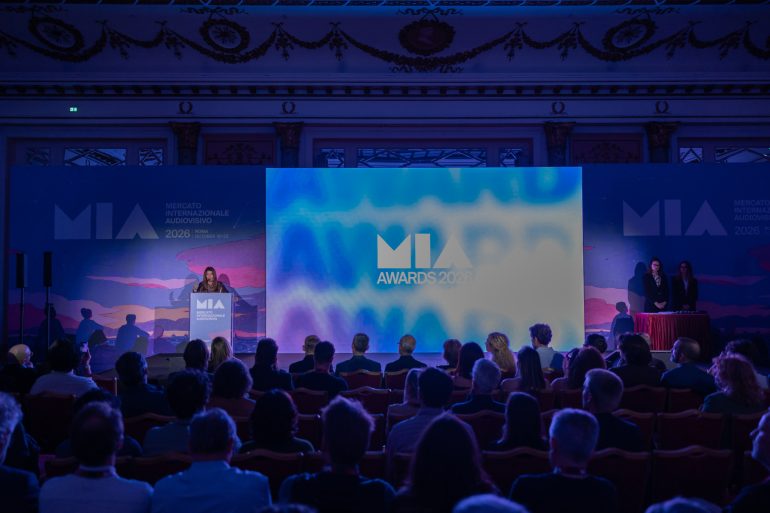
At Rome’s audiovisual market, the region’s projects made a strong showing, while executives from SVT, IPR.VC, DR, Yle and Nordisk Film examined the pressures reshaping production, investment and commissioning.
At Rome’s MIA (19–23 October), Nordic participation stood out both in the project selection and on the conference stage. Productions involving Sweden, Denmark and Finland won three of the five MIA Development Awards, while Nordic executives tackled the challenge of financing distinctive stories and reaching audiences in a fragmented market.
The prizes spanned three sectors. Sweden’s Loving Ika, directed by Emilio Di Stefano and Fabian Sigurd and produced by Daniéla Frykstrand (Gunilla Film), won for documentary, examining AI and emotional vulnerability. Denmark’s Day Traitors (Spioner), staged by Deborah Bayer Marlow and Michael Bille Frandsen (Nordisk Film Production), took the drama award. Penned by Molly Stensgaard, Bo Hr. Hansen and Milad Alami, this espionage thriller explores loyalty, immigration and integration. Finland–UK title The Lost Sons of Nada, by Kyran Davies and Scott Quinn, won for live action, blending surreal comedy, folklore and satire.
But the underlying industry questions emerged away from the ceremony. At the panel “International Broadcasters: Beyond the Co-Production Deal”, SVT's Mikael Österby challenged traditional commissioning assumptions. “We work with needs, not with target groups,” he explained, outlining a shift towards what audiences expect from public-service programming: understanding, inspiration and, crucially, escapism.
Despite adopting a digital-first approach in 2019, SVT faces fierce competition. Österby said storytelling, marketing and commissioning have all changed. For documentary producers, the lesson extends beyond shorter formats: Films need a compelling proposition, relevance to Swedish viewers, and a realistic route to discovery. Local resonance and international appeal need not be opposites. His challenge to documentary producers is clear: Even a strong subject needs a convincing narrative and a plan for reaching viewers.
At the European Investment Hub, Céline Dornier of Finland-based IPR.VC outlined investment models extending beyond individual titles to portfolios of companies, productions and distribution slates. IPR.VC's fully allocated Fund III encompasses ventures associated with A24, MK2, Red Bull Studios, XYZ Films and MUBI; activity linked to Fund IV is anticipated around 2028.
The approach spreads risk across projects and market segments, allowing stronger titles to offset weaker ones. For Nordic independents in small domestic markets, this represents an alternative to increasingly intricate financing plans. Yet raising equity requires a persuasive account of a company's identity, growth prospects and long-term value – not merely another request to close a budget gap. Public funds and private investors can complement each other, although their priorities and time horizons differ.
The drama selection demonstrated several routes to international appeal: Six of its 18 projects had Nordic involvement. Finland's Sherlock North relocates Conan Doyle's detective universe to Lapland; Glassriver's Icelandic project Reykjavík Noir adapts Lilja Sigurðardóttir's novel Snare. Disqualified (Paljastus), a Finnish-led Banijay Finland, Rubicon TV and Filmlance co-production, dramatises the exposure of doping in Finnish skiing. Further details announced at MIA included Laura Birn's involvement.
Sweden's The Making of a Terrorist explores radicalisation through family trauma, while Icelandic–Croatian Volcanic imagines an Icelandic population displaced to Croatia after an eruption. Producers Hörður Rúnarsson (ACT4) and Nebojša Taraba (Drugi Plan) first met at MIA, showing how market relationships can generate actual projects. These contrasting titles illustrate the value of recognisable IP, locally rooted genre storytelling and timely themes. From Disqualified's Nordic partners to Volcanic's Iceland–Croatia axis, the label 'Nordic drama' increasingly describes a production network as well as a storytelling tradition.
Children's television faces similar pressures. At the Children's Pubcasters Meeting, DR's Julie Lind-Holm Hansen and Yle's Vicky Schroderus joined European colleagues in discussing the shortage of domestic content for 10- to 14-year-olds. Traditional age categories increasingly overlook actual viewing habits, while global platforms dominate attention. Executives considered lower-cost digital formats for testing IP before major animation investments, and ways to reach viewers beyond broadcasters' own services. Public-service broadcasters must still meet their cultural remit, even as digital testing becomes cheaper and reaching viewers harder.
In premium drama, Nordisk Film Group financing executive Marike Muselaers moderated a discussion of short-form storytelling, social media and the creator economy. Across these sessions, the key message was not that long-form drama is obsolete, but that producers can no longer assume audiences will discover it unaided.
Practical links mattered too. MIA's financing roundtables convened Sweden's Film i Väst and Film i Skåne alongside Norwegian regional funds. In its first European edition, emerging-talent initiative UNBOX partnered with Nordisk Panorama to select two debut features: Ford by Sweden's Malin Ingrid Johansson (produced by Joel Rostmark), and Out of Athens by Norway's Badrudin Ga'ur (produced by Thomas Robsahm and Vibeke Ringen).
Other Nordic titles showcased at the industry gathering included Palme d’Or winner Fjord (MIA’s Buyers Club), The Seal Mother (Matka Fok) (C EU Soon), and Wallander (GREENLit).
All in all, the prizes, projects and discussions suggest a Nordic industry with no shortage of internationally legible stories, but increasingly demanding conditions for getting them made and seen. The advantage lies less in relying on a familiar regional brand than in combining distinctive creative identities with flexible financing, strong development partnerships and a more precise understanding of audiences.
RELATED POST TO :
FESTIVALS
/
NORDIC INDUSTRY NEWS
/
INTERNATIONAL