Written by: Davide Abbatescianni
21.09.26
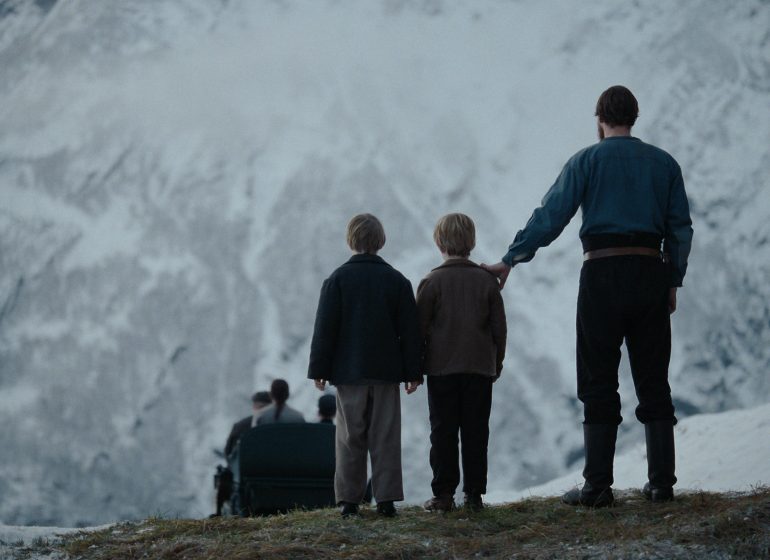
From Sámi narrative sovereignty to buyers seeking acquisitions and Canadian partners, TIFF’s inaugural Market showed where the festival can add value – and why its screenings must remain at the centre.
Toronto has never lacked Nordic visibility. This year, eight Nordic films appeared in the official programme: Amanda Kernell’s Brace Your Heart (Garrat du váimmu) in Platform, Hans Petter Moland’s Growth of the Soil (Markens grøde) in Special Presentations, May el-Toukhy’s Woman Unknown (Kvinde Ukendt) in Centrepiece, Amalie Næsby Fick’s What Lies Between Us (Dobbeltfejl) and Lars Vega’s Arne Goes to Space in Discovery, Sine Plambech’s documentary Rescue, and shorts The End by Niki Lindroth von Bahr and Please by Anna Mantzaris. Market screenings added Halkawt Mustafa’s Venice-bound No Paradise if You Are Killed by a Woman and Ilja Rautsi’s Red Snow (Punaista lunta). By the festival’s close, that Nordic presence had also translated into recognition, with Kernell’s Brace Your Heart receiving the Platform jury’s Special Jury Award.
What changed in 2026 was the industrial framework around them. September 10-16 marked the first edition of TIFF: The Market, giving the Canadian gathering a formal content market alongside a festival that has long functioned informally as a meeting place for buyers, sellers and producers. For Nordic professionals, the question was therefore less whether Toronto could generate attention than whether a dedicated market could turn that attention into more structured access to North American partners.
One answer came from the September 14 panel “North is Now: Indigenous Storytelling in the Arctic”. Anne Lajla Utsi, Managing Director of the International Sámi Film Institute (ISFI), joined Greenlandic-Canadian artist Laakkuluk Williamson Bathory and Nunavut-based producer and performer Vinnie Karetak for a discussion moderated by Indigenous Screen Office CEO Kerry Swanson. Their starting point was co-production, but the conversation quickly moved towards who controls the stories and who retains value from them.
Utsi argued that equality, trust and respect for Indigenous “narrative and creative sovereignty” must be established at the beginning of a collaboration. Recalling ISFI’s work with Disney on Frozen 2, she stressed that ownership must be discussed early, and that Indigenous participation cannot stop at writing or directing: Creators should retain stakes in the work itself. As geopolitical and commercial interest in the Arctic accelerates, she reduced the issue to something more immediate: “It’s not just about the big money and the big politics. This is our home.”
The industrial consequences are equally important. Utsi argued that productions should create jobs allowing younger Sámi generations to stay in their communities as filmmakers, editors and technicians. Toronto provides a potentially useful bridge: Canada has built Indigenous-led screen and funding institutions of its own, while the new Market places those organisations in direct contact with European and circumpolar partners. Kernell’s Brace Your Heart, world-premiering in Platform, supplied an immediate example of a Sámi-led story reaching a major North American stage while remaining embedded in a wider Nordic production structure.
The experience of Nordic buyers, however, suggested that TIFF’s new infrastructure will work best when it reinforces rather than replaces what already makes Toronto useful. Jakob Abrahamsson, CEO of Sweden’s NonStop Entertainment and Mylla Films, noted that TIFF’s decision to host buyers brought back colleagues who had not attended for several years. NonStop acquired Once Upon a Time in Harlem from Autlook and V/H/S Mixtape from Spooky, while Mylla held productive meetings with Canadian producers.
Yet Abrahamsson argues that Toronto’s “beating heart” remains its screenings. Much of the business, he says, still happens between films, around TIFF Lightbox, nearby hotels, cafés and long-established meeting points. That is not necessarily a weakness. Coming only a few months after Cannes, Toronto does not need to reproduce the Marché du Film or build another stand-driven marketplace. Its advantage lies in combining premieres, public response, awards-season momentum and industry activity within the same week.
The current buying climate also limits what any new market can manufacture. Abrahamsson describes “risk aversion” as still dominating the independent business, alongside a sharper polarisation between “must-haves” and “good-to-haves”. He also saw fewer fresh packages circulating, although September’s position immediately after the summer partly explains that.
Norwegian distributor Frank L. Stavik of Fidalgo offered a similarly mixed, but broadly positive assessment. Having sales companies concentrated in a single venue was an improvement on chasing hotel suites around Toronto, while the festival remains an efficient place to sample a large volume of films and benefit from the energy created by the overlap of public and industry audiences. His main reservation was physical: The Metro Toronto Convention Centre felt too large and too detached from the cinemas.
That tension may define TIFF: The Market’s next stage. Its inaugural edition created a clearer business hub, but several of the most useful Nordic experiences still depended on what existed around it: festival screenings, specialised institutional networks, informal meetings and direct encounters with Canadian producers.
For Nordic cinema, that may point to Toronto’s strongest proposition. It does not need to become another Cannes or Berlin. Its opportunity is to shorten the distance between a festival launch and North American business – whether that means a Swedish distributor finding acquisitions, a Nordic producer meeting Canadian partners, or Sámi filmmakers developing collaborations in which access does not come at the expense of ownership.
In other words: the Nordics already know how to travel. TIFF’s challenge, however, is to make what happens after arrival more coherent.
Brace Your Heart, Growth of the Soil, Red Snow, Woman Unknown and Rescue are top financed by NFTVF.
RELATED POST TO :
FESTIVALS
/
NORDIC INDUSTRY NEWS
/
INTERNATIONAL