Written by: Aleksander Huser
15.10.26
In times of AI, an impressive line-up of international speakers joined the Digital Storytelling seminar to “share their experiences rather than add to the speculation.”
Since its founding edition in 2006, the Oslo-based Digital Storytelling has brought together Norwegian and international professionals from the visual effects field for masterclasses, workshops, panels and «fireside talks», as well as informal networking.
Celebrating its 20th anniversary, the Digital Storytelling seminar was held in the Norwegian capital on October 9 with an impressive line-up of speakers and panellists. While Digital Storytelling still uses its established tagline «The Art and Science of Visual Effects», the 2026 edition was named «Art and the New Machine».
This year’s Nordisk Film & TV Fond-supported event also marks a comeback for the VFX industry gathering, which was last arranged in 2016.
«The 20th anniversary was the occasion, but the real reason was timing. A lot has changed in ten years: Real-time production, reality capture as the foundation for much of VFX, and above all generative AI. It felt like the right moment to bring the community back together in Oslo and let practitioners share their experiences rather than add to the speculation,» says Kim Baumann Larsen from Dimension Design in Oslo, co-founder and co-director of Digital Storytelling, together with Angela Amoroso of Seaside Scripts, Oslo, and Eric Hanson of xRez Studio, Los Angeles.
Baumann Larsen and Amoroso underline to NFTVF that Digital Storytelling not only wanted to celebrate its own twenty years, but also the history of Norwegian visual effects itself: «The films and the people, going back to the early years of digital effects here, that newer artists may not know.»
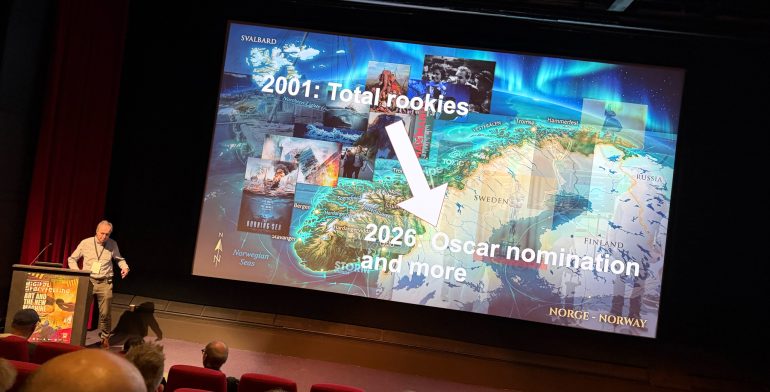
In line with this aim, the day started off with Morten Moen, Associate Professor at Kristiania University College in Oslo, outlining the history of Norwegian VFX from its earliest days to this year’s Academy Award nomination. The prestigious nomination was received by Storm Studios’ Espen Nordahl, whom we will return to, for Sinners.
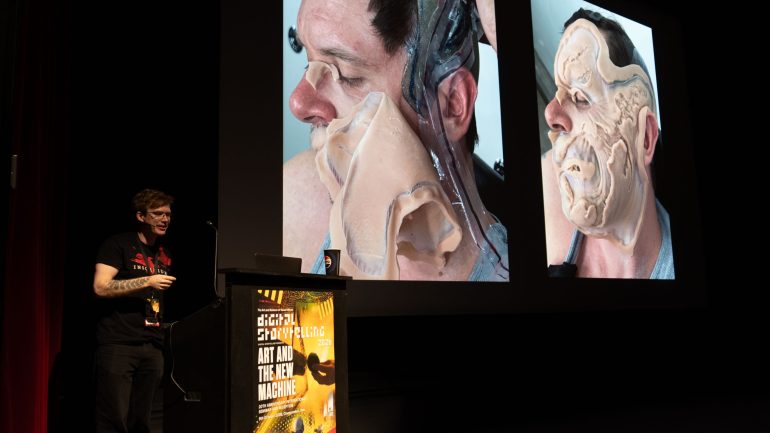
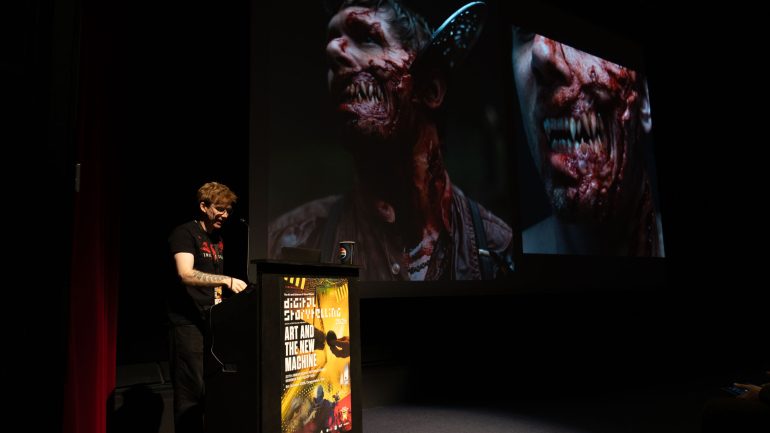
«We’ve noticed a renewed interest in crafting as much as possible from the real, in building from reality rather than fabricating everything. Productions such as Sinners, shot entirely on large-format film with every effect beginning with something real, and Project Hail Mary, combining practical sets and a physical puppet with thousands of digital shots, demonstrate this approach. Neither represents a retreat from VFX; the digital work is grounded in reality and stronger for it,» organisers Baumann Larsen and Amoroso explain about the guiding ideas behind this year’s programme.
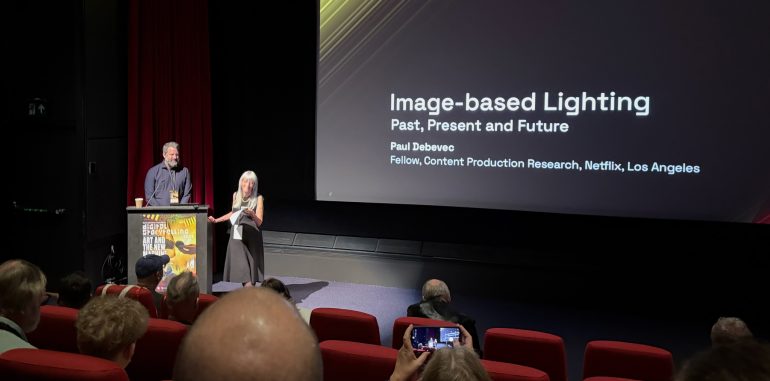
Returning to Digital Storytelling after also being keynote speaker in 2011, the programme was headlined by three-time Academy Award winner Paul Debevec, Fellow, Content Production Research at Netflix, who has been involved in productions spanning from the original The Matrix film to The Mandalorian.
Debevec gave a keynote talk titled «Image-Based Lighting: Past, Present and Future», where he shared insights from his pioneering work on image-based lighting. With this technology, which he first presented in the late 1990s, real-world light is captured in 360 degrees to illuminate digital characters with similar convincing effect as actual actors. The latest development includes huge LED screens projecting digital environments on set that reflect light on the real actors, combined with machine learning that also makes it possible to change the lighting after shooting.
Stuart Penn, Visual Effects Supervisor at Framestore, gave the talk «Practical First: The VFX Behind Rocky & Grace», about the British company’s work on bringing the alien Rocky to life through VFX work alongside a physical puppet in the recent blockbuster Project Hail Mary. Penn’s presentation also covered their work with the film’s zero-gravity sequences, similarly combining digital effects with physical sets, thereby keeping the approach grounded in real performances, sets and models.
Having won a Primetime Emmy Award for Outstanding Special Visual Effects in 2024 for the HBO series The Last of Us, as well as this year’s before-mentioned Oscar nomination for his work on Ryan Coogler’s Sinners, Norwegian VFX Supervisor and Head of VFX at Storm Studios Espen Nordahl was also among the high-profiled presenters at this year’s Digital Storytelling seminar.
In line with Penn’s emphasis on the physically real as a starting point, Nordahl’s talk «On the Shoulders of Giants – Combining Practical and Digital Effects» addressed the renaissance of practical effects and the combination of prosthetics, special effects and visual effects in both The Last of Us and Sinners, as well as other productions.
In this year’s fireside talk, Creative Director Tahir Tanis from Stockholm’s Embark Studios shared his experience from building digital worlds from real places in the video game ARC Raiders.
Despite the increased grounding in reality, the recent evolution of artificial intelligence is hard to ignore. The topic of AI was not least addressed when the programme rounded up with a panel talk under the headline «The Artist and the New Machine», consisting of Theodor Groeneboom from Bergen-based VFX studio Rebel Unit together with Nordahl and Penn. The session was moderated by Jim Thacker, editor of computer graphics website CG Channel.
«We wanted to avoid a programme that simply celebrated AI or opposed it. Instead, we explored craft rooted in the real and the machine as a collaborator rather than a replacement. Espen Nordahl and Stuart Penn brought practical experience, while Paul Debevec placed AI in a longer history of technological invention. The closing panel focused on people actually using AI in their work. We wanted the audience to hear from those doing the work, not just speculating about the future,» the organisers elaborate on the programme.
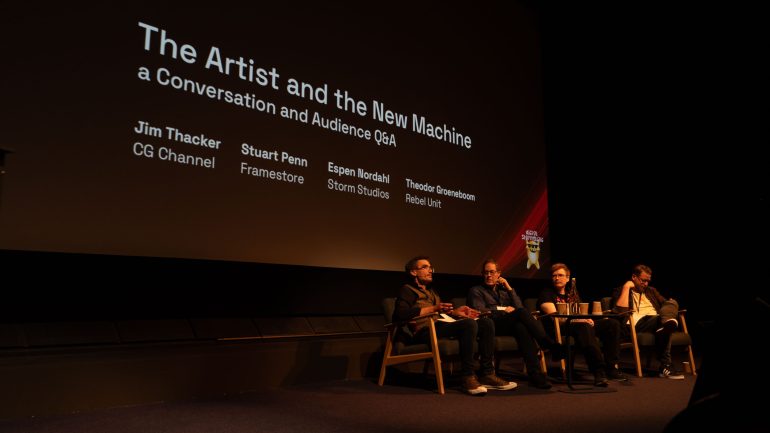
While there was much more scepticism towards generative AI, the closing panel seemed to agree that tools based on machine learning are useful in many respects. However, these tools also have clear limitations, and must be used with caution. After the conversation, little doubt was left on human artists still being very much needed in the centre of real creation. Or, as Nordahl put it: «I’m so uninterested in technology that makes things slightly worse, but faster.»
«VFX depends on human judgment. Understanding a director’s intentions and maintaining continuity across a film cannot simply be replaced by prompting a machine,» Amoroso sums up as a main takeaway from the panel. She underlines that this message is particularly important for newcomers, who are worried about AI and their future.
Another cause for optimism is that the Nordic VFX industry is making a strong mark internationally these days, which of course has not gone unnoticed by the organisers.
«It’s striking how much high-end VFX comes from such a small region, with each country developing its own strengths. Sweden’s Goodbye Kansas excels in game cinematics and digital humans, while Denmark’s Ghost built a strong Hollywood track record over two decades and continues to deliver high-end work from Copenhagen. Norway has a diverse landscape: Storm Studios works on major US film and TV productions; Gimpville, now part of Korea’s M83, is reaching into Asia; and Rebel Unit contributes to major European films,» comments Baumann Larsen.
«What connects these studios is the need to specialise, develop their own tools and build international relationships. Beneath that is a strong tradition of training and craftsmanship, and a respect for getting things right by hand. That was very much the spirit of this year’s seminar,» he adds.
On a finishing note, Baumann Larsen shares that this year’s successful seminar not only marked Digital Storytelling’s anniversary, but was a closing event – at least in this form.
«We started Digital Storytelling to give this work the recognition it wasn’t getting at the time, and much of that has happened. The field has grown up. This felt like a natural point to round it off, while it still means something to the people who come. If someone wants to take the idea further in their own way, we’d be glad to see it.»
Digital Storytelling 20th Anniversary edition is supported by the Norwegian Film Institute (Main Partner), Nordisk Film & TV Fond (Premier Partner), Kristiania University College and Norwegian Film Workers Union (Community Partners), and Grafill Moving Image (Supporting Partner).
RELATED POST TO :
FESTIVALS
& PRODUCTION
/
NORDIC INDUSTRY NEWS
/
NORDICS