Written by: Marta Balaga
10.02.26
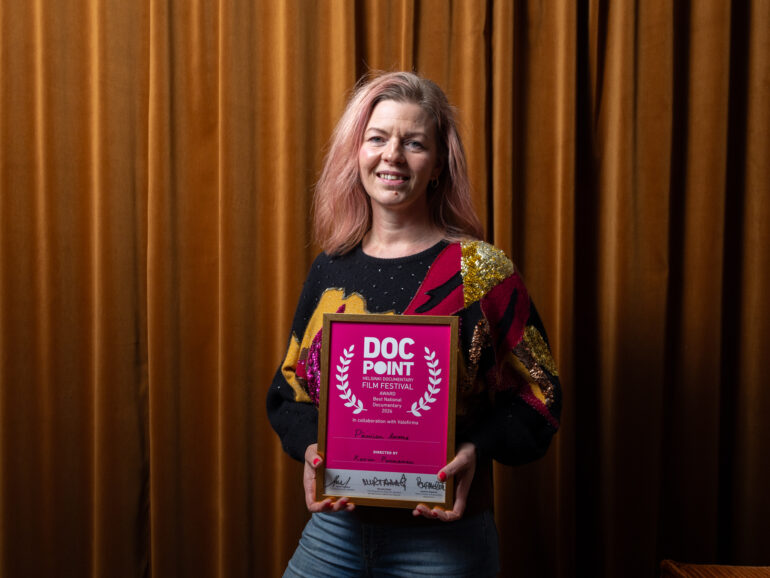
DocPoint – Helsinki Documentary Film Festival wraps anniversary 25th edition – and an exceptionally strong Nordic selection.
The National Competition of the DocPoint – Helsinki Documentary Film Festival has found its winner: Karin Pennanen’s Days of Wonder (Päivien lumo).
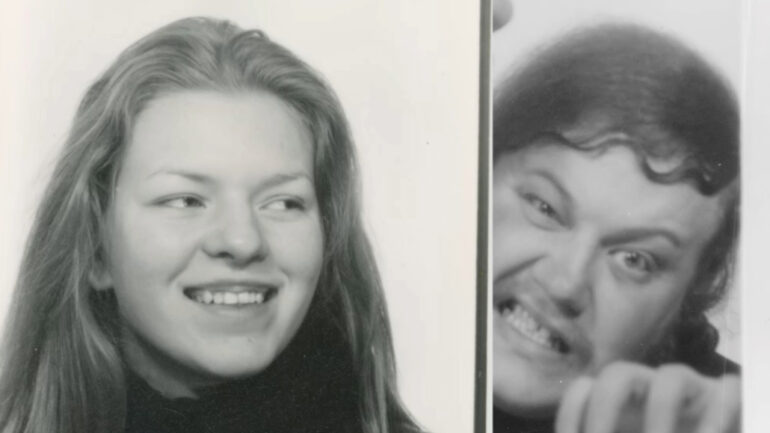
Pennanen has been thinking about making a film about her uncle Markku for years – “Basically ever since I started studying film,” she says. She started right after he passed away.
“I think my motivation was to overcome death. I thought about it a lot while making it, and I thought about cinema in general: Why we, humans, have invented it. I wanted to meet my uncle with the help of cinema.”
He was “never a boring adult” when she was growing up.
“He knew how to make magic tricks, and introduced me to a lot of art. But he never let me into his apartment – he kept that for himself.” Later, he disappeared from her life. “As a child, I never questioned us never visiting him. In Finland, we have big respect for loneliness and integrity, maybe even too much. But he needed space and loneliness for his super rich inner world and art.”
She’s been working on the film for four years, fully immersing herself in Markku’s world.
“I’m very lucky and grateful that I got financing for such a personal film. I realise it works on a universal level. I was in Montreal, and a Brazilian woman came to talk to me. She said she had been thinking about her own uncle throughout the film,” recalls the director, also opening up about the challenging process.
“Because of the huge archive, I had to work a lot for free, even though we got the financing. It wouldn’t be a problem, but I have a mortgage to pay and a family.” Right now, she works on a TV show. “After years of uncertainty, it feels like a safe haven, but I hope I will be able to make more films.”
As “the budgets are so much smaller in Finland than other Nordic countries”, many colleagues – and Pennanen herself – struggle with burnout.
“There should be better structures if we as a society value this kind of art,” she says. “I believe documentary films are so valuable for their deep, complex view on life, humanity and the world. You can’t make them in a couple of months. It takes time.”
Jurors Darko Nabakov, Jasmina Vignjevic and Murtada Elfadl praised the film for “excavating the past with sensitivity and imagination, revealing a complex, layered portrait of a man we only meet in shadows, yet whose presence is powerfully felt”.
The prize awarded to Pennanen is valued at €3,000, including €2,000 in equipment rental from Valofirma and €1,000 in cash from DocPoint.
Celebrating its 25th anniversary this year, DocPoint also awarded Lana Daher’s Do You Love Me (International Competition), with a Special Mention going to Imago by Déni Oumar Pitsaev.
Jani Peltonen triumphed in the National Short Film Competition with archival footage-based documentary Equal Dust (Elämä ja yö), returning to 1980s Helsinki. Jurors Amani Al-mehsen, Antti Lempiäinen and Dario Oliveira observed:
“It eerily combines a four-decade-old NATO exercise and vibrant Finnish Eurovision songs into a chilling reminder of the looming threat of global nuclear war and the devastating potential outcomes.”
Peltonen received a prize valued at €1,000 in equipment rental from Valofirma. Special Mention went to Watchful by Ewa Górzna and Katarzyna Miron. Finally, the DocPoint Apollo Award was given to Dokumenttikilta (The Finnish Documentary Guild).
DocPoint’s Artistic Director Inka Achté notes:
“What runs through our programme is a shared urgency around knowledge, truth, and freedom, and how fragile they have become. We see films grappling with disinformation, the silencing of researchers and journalists, the pressure on democratic institutions, and the real risks of speaking truth to power, whether in Putin’s Russia, within far-right online networks, or in geopolitically charged debates.”

This year saw an “exceptionally strong Nordic selection”, she assures.
“There’s a clear interest in democracy in practice; how free speech, protest, policing, and civic space actually function in everyday life, as seen for example in films like The Dialogue Police (Dialogpolisen) and Hacking Hate. Of course, as a Finnish festival and as a Finnish Artistic Director, films from our Nordic region are bound to resonate strongly with us. I see a shared, often understated sense of humour and a gentle, humane gaze towards protagonists in many Nordic docs, for example in The Ground Beneath Our Feet (Jörðin undir fótum okkar) and Amateurs’ Paradise (Paradis Amatörsins) from Iceland, and Zlatan’s Nose (Zlatans näsa) and ILoveRuss from Sweden.”
Anna Blom’s Amos A – A Portrait of Success and Solitude, D is for Distance by Christopher Petit and Emma Matthews, Tonislav Hristov’s Truth or Dare (Totuus vai tehtävä), Mohamed El Aboudi’s The Last Chapter, Sinna Virtanen’s Etna, Panu Suuronen’s In Full Agreement (Korvia huumaava hiljaisuus), and Invisible Enemy (Ann-Mari Leinonen, Einari Paakkanen) were also among selected Nordic productions and co-productions.
As well as Petri Luukkainen’s When the Saxophone Burns (Kun saksofoni palaa), Vibeke Løkkeberg’s The Long Road to the Director’s Chair, Silent Legacy (Jenni Kivistö, Jussi Rastas), North South Man Woman, Redlight to Limelight and Only on Earth (Solamente en la Tierra).
In Confessions of a Swedish Man, Hampus Linder decided to go to an anti-feminist man camp, only to make some unexpected discoveries.
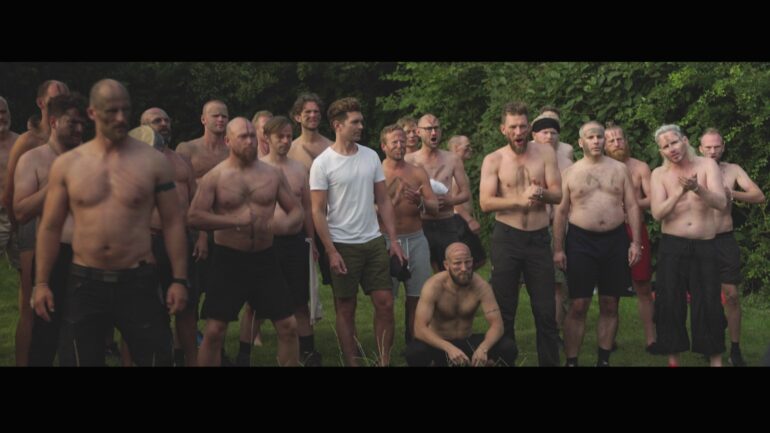
“It’s also a circle of vulnerability, which allows him to look at his own masculinity. People cry, laugh and think, and they talk a lot. When you stay in discomfort – especially if you have different ideologies – it connects people, in a way,” says producer Helene Granqvist.
“It was built on these questions: What is a man today? Why are they like that? We are not solving anything, but we stay in discomfort, and in love that emanates from it. We had people, men, telling us it changed their life.”
As Finland has been struggling with proposed budget cuts, which were eventually overturned, it has been “incredibly heartwarming” to see many sold-out screenings this year, says Achté.
“I have always known Finns love anything to do with Japan, so the popularity of Dear Tomorrow by Kaspar Astrup Schröder didn’t come as a surprise.” Other crowd-pleasing titles included Agatha’s Almanac by Amelie Atkins, Cutting Through Rocks by Sara Khaki and Mohammad Reza Eyni, and The Golden Spurtle by Constantine Costi.
“Character-driven docs with strong protagonists and a David vs Goliath dynamic often appeal to Finns.” And when it comes to The Golden Spurtle, well, Finns love their porridge,” she jokes.
“Maybe it’s also because the world is such a batshit crazy place right now? People need to laugh and stop worrying, even just for a few moments.”
RELATED POST TO :
AWARDS
& FESTIVALS
/
NORDIC INDUSTRY NEWS
/
FINLAND