Written by: Davide Abbatescianni
14.01.26
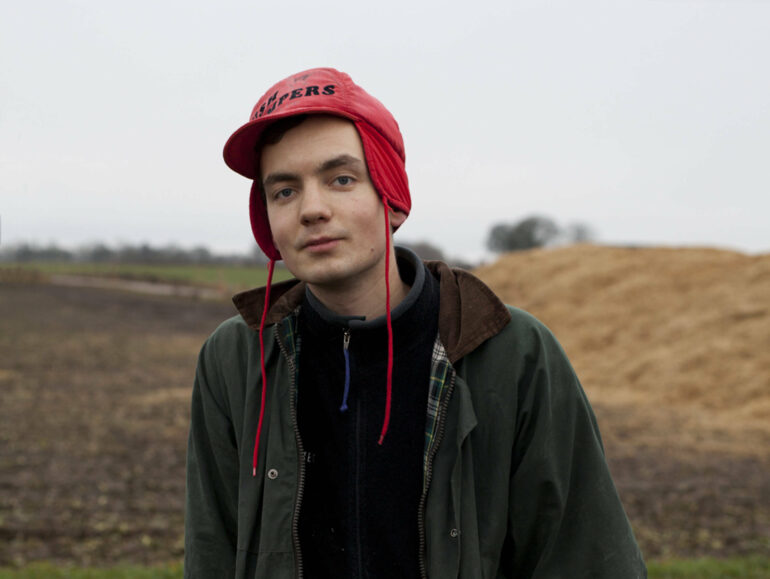
The Swedish helmer chronicles a man building a fortress alone, inevitably reflecting on our present times.
John Skoog’s sophomore feature, Redoubt (Värn), is a black-and-white 35mm narrative starring Denis Lavant, is set to bow at the upcoming Göteborg Film Festival (23 January-1 February). The film, premiered at San Sebastián last year, is top financed by Nordisk Film & TV Fond (NFTVF).
Inspired by real-life farmer Karl-Göran Persson, a farmer teetering on the edge of madness, the story follows his obsessive project to turn his home into a fortified shelter for villagers during the Cold War. Produced by Caroline Drab and Erik Hemmendorff at Ruben Östlund’ company Plattform Produktion in Sweden, in co-production with partners across Finland, the Netherlands, Italy, Denmark, Switzerland, and the UK, Redoubt also showcases a core team of acclaimed European talents.
Co-written by Skoog and Kettil Kasang, with striking cinematography by Ita Zbroniec-Zajt, NFTVF sat down with Skoog at the Maria Cristina Hotel in San Sebastián to discuss the making of this tale, which expands on his 2014 video installation of the same name.
So, a simple start: how did you begin working on Redoubt, and how did you balance fact and fiction, given the real-life figure it’s based on?
I’ve been working on this story for a long time - I made a museum installation and a short film about it first - so the balance between fact and fiction was something I’d already approached. For this film, we used documentary material more as myth than biography. When writing the script, we already knew Denis was interested in playing the role, which introduces a layer of fiction since he’s a Frenchman speaking Swedish. We drew from interviews, anecdotes, and memories, sometimes taking poetic license - for example, the scene where he hypnotises a hen is fictional, inspired by his skill with animals and the fact kids liked being around him. We had our first good draft ready in 2021.
Why did you move the story to the post-war period?
The real Karl-Göran Persson lived from 1894 to 1975, and his paranoia was shaped by the Cold War. This bunker project wasn’t the idea of a young man - it happened in the second half of his life. We shifted the timeline slightly for dramatic purposes: Parts of the film, like the winter sequences, could be seen as taking place in the late 70s or early 80s. This highlights how, as the Cold War waned and the Berlin Wall fell, the bunker’s purpose became increasingly obsolete - it was meant to protect against a Soviet invasion, but by the 80s it was clear that wasn’t going to happen.
Speaking of aesthetics, why black-and-white on 35mm?
It was essential to achieve a tactile, physical feel. Textures of the house, materials, and the environment come alive in black and white. It also situates the film in a past memory, giving viewers a sense of temporal distance.
Denis Lavant’s performance is central. How did you engage him, and how did he manage to act in Swedish?
The idea of having Denis on board was almost a joke at first, but it truly made sense. We discussed logistics, language, and dubbing, and ultimately he learned the Swedish lines phonetically - a mix of standard Swedish and the southern dialect of Skåne. A translator helped with French-Swedish transitions. My mother served as his dialect coach. His physicality and improvisation were crucial, shaped both by the script and on-set experimentation.
Did you shoot in Skåne?
Yes, near my childhood home, on my cousin’s land. Filming lasted six weeks in summer 2023 and two weeks in winter - eight weeks total.
What about your approach to post-production? Did you give ample freedom or were you quite present in the editing room?
Very collaborative. I edited with Jussi Rautaniemi, and sound with David Gülich and Anne Gry Friis Kristensen. Sound was integral to the rhythm, and I spent most of the post-production immersed in it.
How did you handle multiple co-production partners?
It was my first time working on such a large international co-production. Meeting everyone beforehand helped build trust. European funding structures are complex, but we found partners who fit our vision. Co-productions bring challenges, but with the right team, they also allow creativity.
Were there any technical difficulties you’d like to highlight?
The location was challenging - remote, unconventional, a literal field. But practical obstacles shaped production creatively. Editing across countries added logistical complexity - Jussi is based in Helsinki, I live in Copenhagen - but with careful planning, everything worked out.
One last, inescapable question. Did current geopolitical events influence the making of Redoubt?
Sure. I’ve read that Europe is spending more on the military than since 1987. I was thinking about this character before all of this, so my interest isn’t simply a reflection of the current situation. Even without today’s politics, we live in “end times”, with the looming ecological disaster, which raises existential and more mundane questions - should I buy organic or regular milk? It’s a privileged kind of doom. I was also drawn to the artistic obsession: when a life project takes over you, a major theme of the film. Another is what it means to live outside the planned path, in the “periphery”, and how that shapes the community and vice versa. War resonates with our times, which helped the film’s funding, but the film doesn’t address the Ukraine war directly - it invites reflection. In Europe, our energy consumption is extreme. The character built his house entirely manually, at a time when manual labour was disappearing. His bunker reflects ideas of energy, effort, and how we live our lives. The security pamphlets Denis recites - published from 1943 to 1991 and republished in 2018 and 2025 - underscore this.
RELATED POST TO :
PRODUCTION
/
NORDIC INDUSTRY NEWS
/
SWEDEN