


From cosy Hallmark romances to spicy HBTQ+ love stories – the appetite for feel-good escapism and romcom is surging. Yet despite the buzz, filmmakers say getting new projects off the ground can be a challenge.
“Everyone claims they want romcoms, but no one dares to invest in them,” says Swedish screenwriter Wilhelm Behrman.
Interest in romantic series and comedies – so-called romcoms – is heating up. The trend was evident during this year’s MIPCOM TV-market in Cannes. In a world marked by political turmoil, war and economic instability, audiences are turning to light-hearted entertainment, love stories, and feel-good escapism.
Steve Matthews, Head of Scripted at Banijay, has seen similar tendencies, and points to series like Diary of a Ditched Girl (Halva Malmö består av killar som dumpat mig), which climbed the Netflix charts.
“Romance is hot right now. When we talk to production companies and creators, there’s a lot of interest across many of our territories in this genre,” Matthews noted during MIPCOM.
Another example: Danish film sales and aggregation house LevelK recently launched RomComTV, a new FAST-channel dedicated entirely to the genre. Streaming on Samsung Smart TVs in the Nordic market, the 24-hour line-up of romantic comedies could easily become a hit among feel-good fans.
But despite the growing demand, several screenwriters and directors tell NFTVF that getting a romcom project greenlit can still be surprisingly difficult.
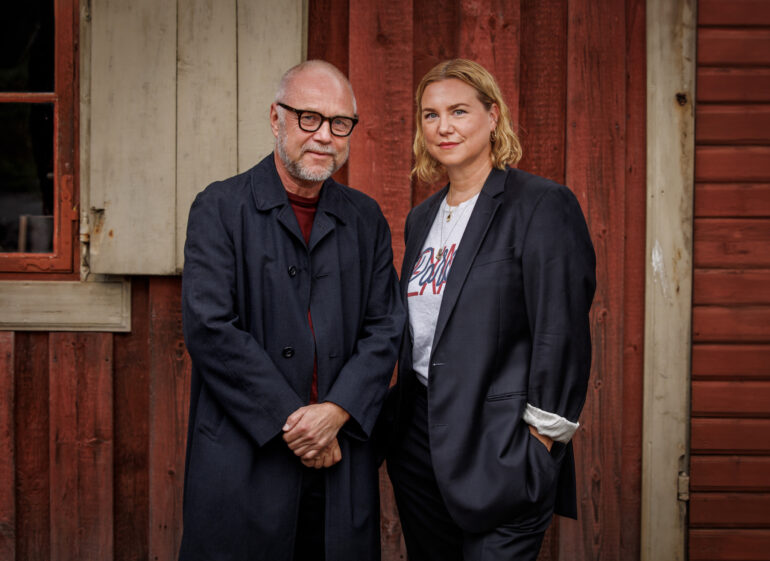
Psychologist and writer Wilhelm Behrman, whose lighthearted romcom Couples Therapy in Gagnef (Parterapi i Gagnef) recently premiered on SVT, knows that struggle well. It took him ten years to find someone willing to take a chance on his script.
“I think it comes down to fear. People aren’t used to making romcoms, they don’t dare. Everyone says they want them, but when it comes down to it, they’re too afraid to actually make one,” he says.
Director Lisa James Larsson, who directed Ronja the Robber’s Daughter (Ronja Rövardotter) and A Royal Secret (En kunglig affär), shares a similar view.
“Nobody Wants This did really well last year, and the new Bridget Jones film was beautifully written. When several things – for instance a film and a series – succeed, you can feel a movement building towards creating more of the same content. But investing in it is something else entirely. Adolescence was brilliant, but you can’t suddenly start making a whole range of one-take series like that.”
She believes the timing might be right for love stories.
“I think people are craving warm, affectionate stories right now, because we’re living in such a dark and frightening time. Many people want escapism, and I hope we’ll see more of these kinds of stories, as long as they’re told at a high level.”
Creating a great romcom is a real challenge, according to Lisa James Larsson.
“It’s important not to generalise or try to make something you think people will find funny. You have to take comedy seriously, not make the characters or their actions dumb. A bad romcom is awful. You have to believe in the story, the logic, the characters’ drive and their love for each other. It has to be built on something real, it can’t just be that they see each other across a crowded room and then – bang, they fall in love.”
At the same time, the stereotypical romantic comedy, set for instance in a picturesque American or British small town with a bakery or a vineyard, à la Hallmark, is being challenged. For years, the genre often featured a homogeneous cast with traditional gender roles. Now, diversity is increasingly coming into play.
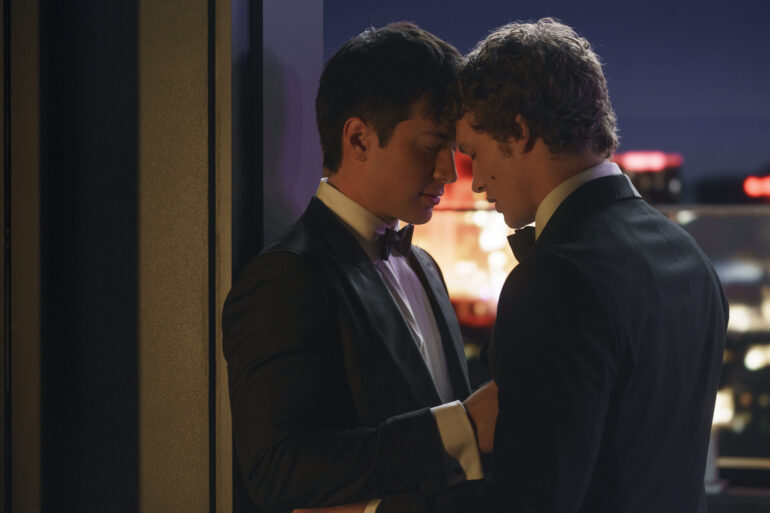
The Canadian spicy romcom Heated Rivalry is set in the world of ice hockey, and tells the gay love story between rival Major League Hockey players Shane and Ilya. Over an eight-year period their secret romance outside the limelight turns into love. Based on a hit book series by Rachel Reid, it belongs to a sub-genre of erotic romance known as MM (Male/Male).
Director and screenwriter Jacob Tierney (Letterkenny, Shoresy) says he fell in love with the books after reading them.
“One day I read an article in The Washington Post about the romance industry and why it’s a billion-dollar-a-year business. The subheadline was, ‘Why are hockey romances so popular?’ And within the first two paragraphs, they mentioned Heated Rivalry. I thought, if somebody else options this, I’ll lose my mind. So I followed Rachel, the author, on Instagram and reached out to ask if she’d be open to optioning the book. And she said yes.”
The book series has a huge fanbase online that’s been following the project closely. The first images from the series went viral when they were released, reaching over a million impressions and 70,000 engagements within just a week, says Tierney.
“There’s an audience – primarily women – who’ve been underserved in this genre,” says Tierney. “They want these stories, but nobody has been making them or taken them seriously. We’re not chasing an audience that doesn’t exist; we’re giving an existing audience exactly what they want.”
He says that sport is not such an unusual ingredient as one might think within the world of romcoms.
“I don’t think it’s been translated much to the screen, even if it’s common in books. One of the first shows that came to mind when we started developing this, was Young Royals. What we’re doing is kind of an older version of that story, even if this is set in the world of ice hockey. I used Young Royals as an example to the cast of what great chemistry looks like.”
In Couples Therapy in Gagnef, life takes a nosedive for psychologist Nisse after he accidentally leaves a pile of confidential papers on a bus. Fired from his job, abandoned by his partner, and forced to move into a crumbling old house, he soon finds himself starting over in the small village of Gagnef, Dalarna – where the charming Rebecka works in the local hardware store.
“Comedy is always scary, because there’s nowhere to hide,” says actor Joel Spira, who plays Nisse. “In drama, you can always mumble a bit and look brooding. But in romantic comedy everything has to click, and you have to be on point.”
“Romcoms can sometimes feel formulaic, like they’re stamped out of the same mould, and nobody cares much beyond that. In this case, the script was very intelligently written, and the characters have depth. And the situations become genuinely funny. It’s a romcom with real substance and heart.”