Written by: Davide Abbatescianni
05.11.26
On how Nordic expertise shapes global productions, from House of the Dragon’s creative previs to practical engineering.
For Daði Einarsson, visual effects are not merely the finishing touches added after a camera stops rolling. Speaking at VIEW Conference in Turin (October 12-16), the Icelandic overall production VFX supervisor of House of the Dragon’s third season described a process in which his team helped design shots, shape action and solve complex production problems long before filming began.
The centrepiece of his presentation was the Battle of the Gullet, a sprawling naval confrontation involving dragons, ships and vast stretches of open water. Its roughly 25-minute sequence required not only substantial digital work, but also specially engineered physical sets, demanding coordination between filmmakers, technicians and several VFX companies.
Einarsson’s involvement also illustrates the international reach of Iceland’s visual effects industry. He began his career at the pioneering Icelandic animation and computer graphics company OZ in 1992, later worked in London and New York, and co-founded Reykjavík-based RVX in 2008. The Icelandic studio was among the vendors contributing to the season, alongside international companies including Wētā FX and Rodeo FX.
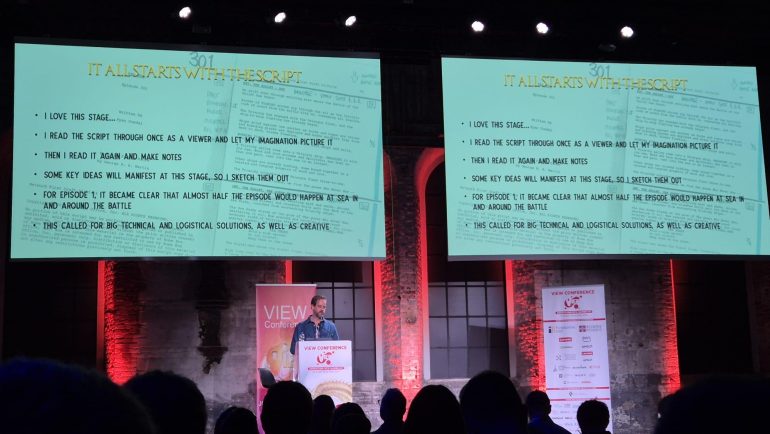
His workflow begins with two readings of a script: first as a viewer, letting images emerge instinctively, then as a supervisor assessing shot counts, budgets and technical constraints. For the sea battle, creative planning quickly became a question of industrial scale. The eight-episode season, he said, was effectively like trying to make “four feature films at the same time”, with directors, crews and departments working in parallel.
Previsualisation – or previs – proved central to that effort. Rather than treating it as an approximate technical guide, Einarsson placed it at the heart of creative decision-making. “For me, previs is actually one of the most creative parts of what we get to do,” he said. “We’re actually creating shots, we’re doing composition, we’re doing lensing.” The team used the production’s actual lens choices and developed the timing and staging of dragon movements before actors stepped onto the set.
Einarsson compared the process to painting: The sketch captures the initial spark, while the finished work adds realism and polish. Crucially, accomplished creature animators also joined the previs teams. Some dragon sequences were already close to their final timing and sense of weight at that stage, allowing the animations to inform the movement of mechanical rigs and motion-control cameras used to film the riders.
Real-world reference was just as important for the ships. The team went to sea with instruments to record a vessel’s pitch and roll, then translated the data into digital animation. Those movements informed the design of hydraulically operated ship sets on the backlot. A dry stage accommodated movement and deck fighting; a specially built wet tank allowed ships to collide and actors to interact with water. According to Einarsson, the latter contained approximately three million litres of water, maintained at 27°C and circulated through a purpose-built filtration system.
The insistence on physical reference extended to the dragons themselves. Einarsson described developing a kind of “dragon photography”: camera movements that might plausibly be achieved if the creatures actually existed. “We don’t want it to be fantastical,” he said of the camerawork, explaining that even extraordinary images need to remain grounded in recognisable cinematic language.
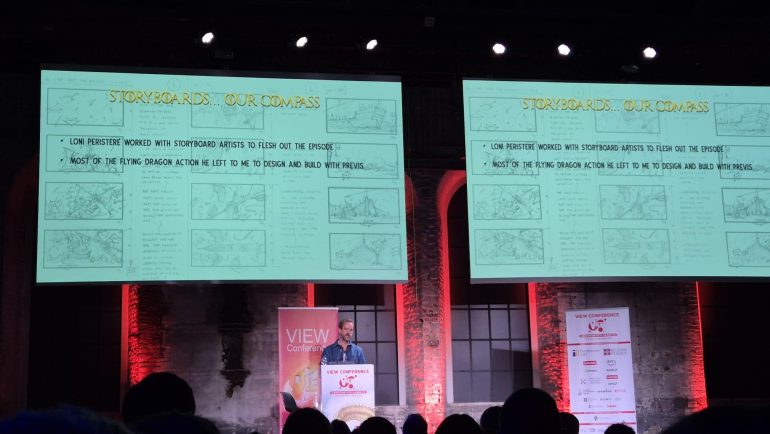
The collaboration reached into the editing room. Working with director Loni Peristere and the editorial team, Einarsson helped assemble a continuously updated “supercut” of the battle, replacing storyboard frames with previs as sequences developed. The unusually open process allowed the VFX team, director, editor and showrunner to identify storytelling problems while there was still time to alter the plan. For Einarsson, that early access meant visual effects artists could contribute to the episode’s dramatic structure rather than merely execute instructions after the edit.
Managing the resulting workload across studios was another production challenge. Einarsson described regular reviews with individual vendors, supported by coordinators and production managers, but also said he encouraged companies to communicate directly with one another when exchanging assets and solving shared problems. Live-action and location plates, including drone footage, helped establish a common reference for elements such as water colour, waves, light and atmosphere – particularly valuable when different facilities had to deliver a consistent visual world.
During the Q&A session, Einarsson recalled how friends in Iceland had pooled money to buy computers, bringing together entrepreneurial, programming and artistic skills. The contrast with today’s vast production machinery was striking.
The lessons extend beyond the resources available to a major HBO production. Einarsson’s career, from a small Icelandic CG company to supervising one of television’s most demanding fantasy franchises, points to the place highly specialised Nordic talent and companies can occupy within distributed international pipelines. What makes that expertise valuable, his VIEW presentation clarified, is not simply the capacity to produce polished images, but the ability to participate in storytelling, engineering and production planning from the outset.
RELATED POST TO :
PRODUCTION
/
NORDIC INDUSTRY NEWS
/
ICELAND
& INTERNATIONAL