Written by: Annika Pham
04.05.17
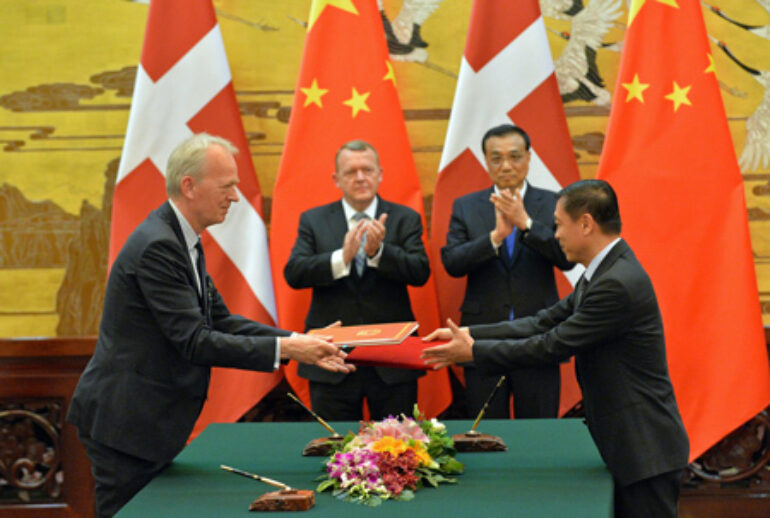
The ground-breaking deal signed on Wednesday in Beijing by Danish and Chinese officials is the first of its kind in the Nordic region.
The co-production treaty which was negotiated by the Danish Film Institute and China's SAPPRFT (State Administration of Press, Publication, Radio, Film and Television) will allow qualifying Danish/Chinese co-productions to access national benefits including sources of finance and an easier distribution in both territories. The key advantage for Danish producers is that eligible co-productions will not be subject to China’s import quota on foreign films, restricted to a maximum of 38 films a year.
The DFI’s CEO Henrik Bo Nielsen said: "The agreement will be important to both parties, both economically and culturally. A co-production agreement will make it easier for Danish companies to get access to the enormous Chinese theatrical market, where even small Danish films can reach quite a large audience. The DFI's international department has been working on the agreement for a long time and we are sure that Danish companies will be able to seize the opportunities. Culturally, too, there is something to be gained. The encounters that take place when we exchange and cooperate on art and culture are both inspiring and necessary for mutual understanding and good relations across national borders."
Films that usually pass through the strict cultural and content restrictions in China are family-oriented titles, including animation films. The last Danish film that was released in China and passed through the quota system was Kenneth Kainz’s fantasy film The Shamer’s Daughter, sold by TrustNordisk.
Zentropa’s sales arm has been actively building trust relationships with Chinese partners over the last couple of years under CEO Rikke Ennis’s aegis.
Copenhagen Bombay is also working on a Danish-Chinese project according to the Danish Film Institute, and Bille August has finished directing the WW2 drama The Chinese Widow starring Emile Hirsch, Yifei Liu and Yu nan. The director has also opened a studio in the city of Hangzhou and acts as the city’s cultural consultant.
The Danish/Chinese film co-production agreement was signed on Wednesday in connection to Danish PM Lars Løkke Rasmussen’s state visit to China.
The Danish-Chinese film delegation compromised Bo Østergaard (VD, Danish Cultural Centre in Bejing), Henrik Bo Nielsen, Guoqui Li (Deputy Director General, SAPPRFT), Susan Xu (Vice President, China Film Co-production Corporation) and Chun Liu (Division of International Cooperation, SAPPRFT).
China has a total of 13 film co-production agreements. The last one was signed with Estonia in 2016 and the very first one in 1987 with Canada.
RELATED POST TO :
PRODUCTION
/
NORDIC INDUSTRY NEWS
/
DENMARK