Written by: Davide Abbatescianni
21.09.26
From fewer episodes to earlier co-production, this year’s slate exposed how quickly the region’s development and commissioning model is changing.
Six Nordic projects arrived in Toulouse with markedly different creative identities, but a common industrial reality: In a tougher commissioning climate, international partnerships are increasingly becoming a structural necessity rather than an optional route to expansion. Cartoon Forum’s 37th edition, held September 14-17, selected 66 projects from 111 submissions, including six Nordic titles and 26 international co-productions.
Finland fielded two projects. Anima Vitae’s Minifauna, created by Mariko Härkönen, is a non-dialogue slapstick comedy starring amphibians in a photorealistic Finnish forest. Speaking to NFTVF, producer Timo Suomi says development began just as the downturn in broadcaster and streamer commissioning hit, but the longer process also allowed the team to experiment with a Gaussian-splatting workflow combining captured forest environments with traditional animation. Yle has provided a letter of commitment, while Nordvision development support followed votes from DR, SVT and RÚV.
Animagency’s Epic Family, created by Ami Lindholm, Tero Suomela and Sanna Stellan, looks instead at the exhaustion and absurdity of contemporary parenting. Development and a pilot are nearing completion, with around 10% of the first season financed. At Cartoon Forum, the priority was attracting broadcasters and streamers, followed by distributors and co-producers. Suomela describes the project’s Finnishness as “spice rather than the main focus”, arguing that recognisable family situations ultimately give it international potential.
Denmark’s Made by Us presented Scraplings, produced by Katrin Quist-Møller, a comedy for younger children built around small creatures reinterpreting discarded human objects through play. Supported in development by the Danish Film Institute and holding a letter of commitment from DR, the series is ready for production. Quist-Møller says the international market is becoming “almost a necessity”, since domestic funds and broadcasters can no longer finance animated series alone, pushing producers towards wider co-production structures and pre-sales.
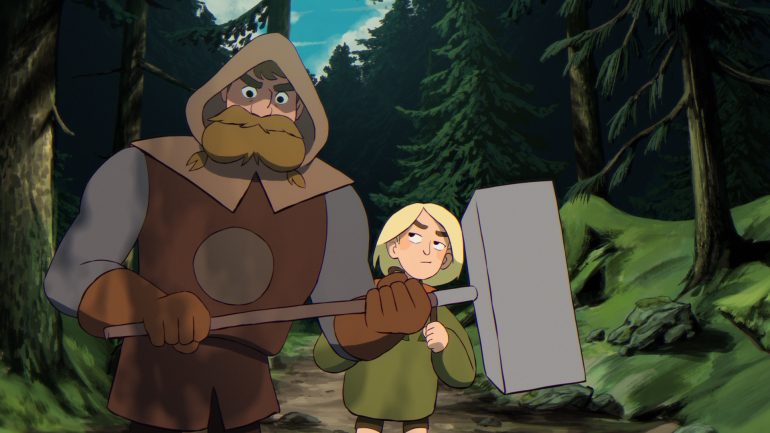
Also from Denmark, Skjaldborn’s Valdra is a 2D fantasy adventure about eight-year-old Astrid entering a magical world and joining a warrior and a druid on a quest through enchanted lands. The project has already passed through Animation Production Days, and is also heading to Young Horizons Industry, reflecting how many European animated projects now move through several development and pitching platforms before reaching production.
Swedish studio Uncloudy & Co brought the Greek-Swedish Dream Tango, a science-fiction mystery in advanced development. Andreas Panagiotopoulos and his team have completed the pilot script, series bible, character arcs, season outlines and concept trailer, while seeking the remaining financing and strategic partners. The IP also extends into VR gaming, although Panagiotopoulos stresses that this is a long-term creative strategy rather than a financing shortcut. He describes it as less a specifically Nordic work than a European project combining contemporary science fiction, Greek mythology and a Mediterranean setting.
Norway’s sole lead project, LØV Film’s Scope of the Universe, sits in another difficult financing space. Produced by Lillian Løvseth and co-produced with Czech company Bionaut, the 12+ hybrid animated documentary combines science and philosophy with a fictional astronaut travelling through the history of the universe. Løvseth says hybrid animated documentary can fall between established funding categories, particularly when aimed beyond preschool, making broadcasters, streamers and sales partners able to understand the format especially important.

From the broadcaster side, Gudrun Jónasdóttir, NRK’s Deputy Head of Acquisitions Children and Y/A, sees those financing pressures feeding directly into what gets made. “We see fewer projects willing to take risks,” she says, noting that many titles entering production are now based on established franchises. High production costs are also affecting volume: “The number of episodes is often lower than before.”
That caution does not mean broadcasters are short of ambitious ideas. Jónasdóttir says series for tweens and young teenagers remain some of the most creative projects presented annually at Cartoon Forum. At NRK, live action continues to dominate programming for 10-14-year-olds, but the broadcaster is still actively seeking animated series for that audience.
For Nordic projects hoping to travel, she sees no repeatable formula. “Authenticity first and foremost – alongside a bit of luck,” she says, while pointing to strong scripts and relatable, distinctive characters as fundamentals. The lengthy development cycle of animation complicates matters further: Producers and broadcasters are effectively trying to anticipate what audiences will want several years later.
Her comments also point to shifts in what Nordic public broadcasters buy from abroad. Norway, Finland and Denmark are acquiring more Asian content, particularly anime, while at Cartoon Forum NRK continues to look above all for “good stories” and strong comedy.
DR commissioning editor Julie Lind-Holm Hansen offers a complementary Danish perspective. She says involving children throughout development remains central to DR’s approach, with shared family humour proving especially effective: “When the parents laugh, the children laugh with them.” On financing, she notes that “the vast majority of projects require some international financing”, but argues that this need not dilute specificity: “having international potential doesn’t necessarily mean making a project more generic. Perhaps quite the opposite.” She also sees established IP increasingly moving into animation across platforms, adding that “streaming and linear TV don’t necessarily have to be at the centre of a project anymore.”
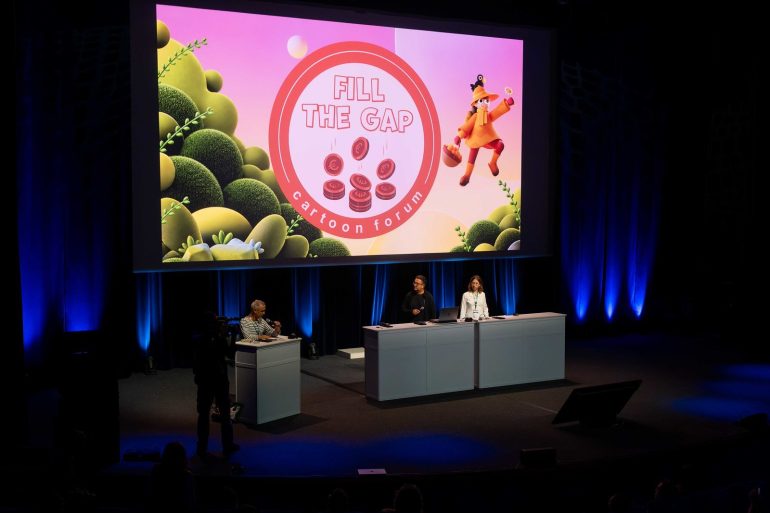
The financing challenge was also visible in the structure of this year’s Forum. Fill the Gap, designed to reconnect previously pitched projects with buyers and financiers, returned as part of an industry environment in which assembling final financing packages has become increasingly difficult.
Cartoon Forum also expanded its international reach through the first official joint Québec-Canada presence at Cartoon Forum, with six projects presented under the “Québec-Canada Land in Europe” initiative. Its explicit emphasis on building bridges with European producers and financiers echoed the logic visible across much of the Nordic slate: Projects may originate from strongly defined local creative cultures, but their path to production increasingly depends on relationships built well beyond their home markets.
The Cartoon Tributes offered a final snapshot of the ecosystem. The BBC was named Broadcaster of the Year, Folivari International Investor/Distributor of the Year, and Bobby Prod Producer of the Year, while Gao Shan Pictures received the inaugural Ecoprod-Cartoon Tribute for sustainability. SVT was among the broadcaster nominees, whilst Bionaut – co-producer of Scope of the Universe – was shortlisted for Producer of the Year.
All in all, the Nordic projects and broadcaster perspective suggest an animation sector still generating distinctive ideas, but operating within narrower financial margins. Longer development, fewer episodes, reduced appetite for risk, and earlier internationalisation are becoming part of the same equation. In that environment, co-production is increasingly less about making a project bigger than about making it possible at all.
RELATED POST TO :
FESTIVALS
/
NORDIC INDUSTRY NEWS
/
NORDICS
& INTERNATIONAL