Written by: Davide Abbatescianni
19.05.26
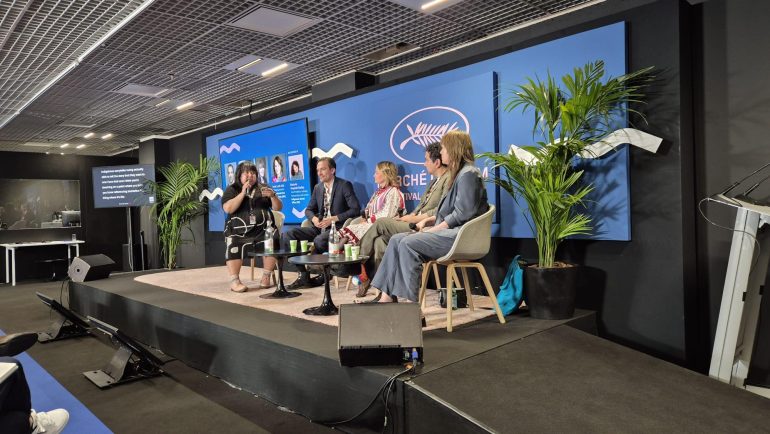
At the Marché du Film, Indigenous film leaders discussed cinema as a tool of cultural sovereignty, cross-border collaboration and resistance in times of geopolitical pressure on the Artic.
The 14 May Cannes impACT panel Arctic Storytelling and the New World Order, presented by the International Sámi Film Institute (ISFI) and the Indigenous Screen Office (ISO), brought together Ánorâk Film producer Emile Hertling Péronard, Arctic Indigenous Film Fund CEO Jason Ryle, ISO CEO Kerry Swanson and International Sámi Film Institute (ISFI) Managing Director Anne Lajla Utsi. The talk was moderated by ISO Vice-President Melanie Nepinak Hadley,
First, Péronard said Arctic cinema is still in the process of defining itself. Greenland’s own film history, he noted, only began around 25 years ago, with its first romantic short released in 1999 and its first romantic feature in 2009. Before that, Greenlandic stories were largely told by others. “We told the stories, and someone else wrote them down. And later on, we told stories and other people filmed them for cinema,” he said. The task now, he added, is not only to correct past misrepresentation, but to move beyond it: “To be free of the prejudices or the clichés that were told about us, and just tell the stories that we want to tell.”
Next, Ryle placed Arctic storytelling within a longer Indigenous film history, recalling Zacharias Kunuk’s Atanarjuat: The Fast Runner, which won the Caméra d’Or at Cannes in 2001. Kunuk’s acceptance speech in Inuktitut, he said, became “such a beacon of pride”, even though translators were not prepared for the language. For Ryle, looking at the globe from the top rather than through conventional maps reveals the Arctic as a connected space, marked by diverse cultures, but also by shared histories of colonisation. Arctic cinema, he argued, is “one of the most exciting areas of global cinema”, bringing forward stories that may be thousands of years old while remaining deeply contemporary.
Swanson stressed that the issue is not simply representation, but ownership and control. She recalled that when Atanarjuat was made, Canada’s national funder Telefilm did not support Indigenous-language content, forcing Kunuk to seek alternative routes. Although Indigenous languages are now supported, she said inequities persist. The creation of the ISO eight years ago responded to the fact that Indigenous storytellers were still not accessing funding at the same levels as non-Indigenous people making films about Indigenous communities. “Nothing about us, without us” became central, she said, with narrative sovereignty grounded in Indigenous ownership.
From the Sámi perspective, Utsi recalled Nils Gaup’s Pathfinder (Ofelas), released in 1987 and later nominated for an Oscar. Gaup, she said, fought for a decade to finance the film, because funders doubted anyone would want to see a film in Sámi. Watching it as a teenager in Guovdageaidnu was ”life-changing”, she said: “It was the first time we saw ourselves, our people, our traditions, language. We heard Sámi language on a big cinema screen for the first time ever.”
That experience later fed into the creation of ISFI, founded 15 years ago because Sámi filmmakers could not secure sufficient support through national systems. The goal was to fund Sámi-language films by Sámi filmmakers. Utsi said this has enabled a new generation to move into features and series, while institutions such as ISFI, ISO, AIFF and the newly launched Greenlandic Film Institute now form an Indigenous-led network across the circumpolar Arctic.
Yet funding structures remain a major obstacle. Péronard cited the documentary Twice Colonized, a natural Greenland-Canada Inuit co-production that still required complex legal and financial “gymnastics”. His Greenlandic company could not access Danish Film Institute support directly, while the Canadian Inuit co-producers lacked the track record required for mainstream Canadian funding. “It would be ridiculous to not share our common storytelling when we share our language, our culture, even our colonial histories,” he said.
Swanson said the ISO, which currently administers CAD$ 24 million, has had to push the Canadian government for flexibility in how it spends public money. One key demand is the ability to fund across borders without forcing Indigenous collaborations through traditional treaty co-production models. Such mechanisms, she argued, should be understood as part of Indigenous self-determination.
The session also addressed the renewed geopolitical pressure on the Arctic. Péronard said the recent international attention on Greenland had produced both fear and opportunity. Some Greenlanders, he said, were discussing whether they would need to leave cities or hide in fjords if an invasion came. At the same time, global production companies are now approaching Greenlandic producers more frequently. Some approaches feel extractive, he warned, while others offer meaningful collaboration, rights and space for Greenlandic producers to shape projects ethically.
Ryle said Arctic Indigenous cultural work can also support the sovereignty goals of nation states such as Canada and the Nordic countries. The challenge is ensuring governments recognise culture as part of Arctic policy, not as an afterthought. Utsi agreed, warning that Nordic debates about defence and military presence in the North often overlook “the power of culture as a defence also”.
Swanson was blunt about the gap between political rhetoric and financial commitment. Many decision-makers now understand the argument, she said, because the work exists and audiences respond to it. “I have a lot of people agreeing with everything I’m saying, but the money doesn’t come,” she said. “Where is the money?”
The speakers pointed to recent Sámi successes, the comedy series A Sámi Wedding (Heajastallan - Bryllupsfesten), and Elle Sofe Sara’s joikfilm Árru, both supported by Nordisk Film & TV Fond, as well as to the Canadian Inuit comedy series North by North. Greenland’s growing institutional base was seen as a sign of a more contemporary, genre-diverse Arctic screen culture. Péronard said the goal is not necessarily to make every production with an entirely Indigenous crew, but to ensure Indigenous writers, directors, showrunners and owners are in control.
For Utsi, the next step is clear: the institutions now exist, but they need resources. “The only thing we lack is the funding, the big money,” she said. “So we can support all our talents.”
RELATED POST TO :
FESTIVALS
/
NORDIC INDUSTRY NEWS
/
INTERNATIONAL